 Dr. Yashwant Singh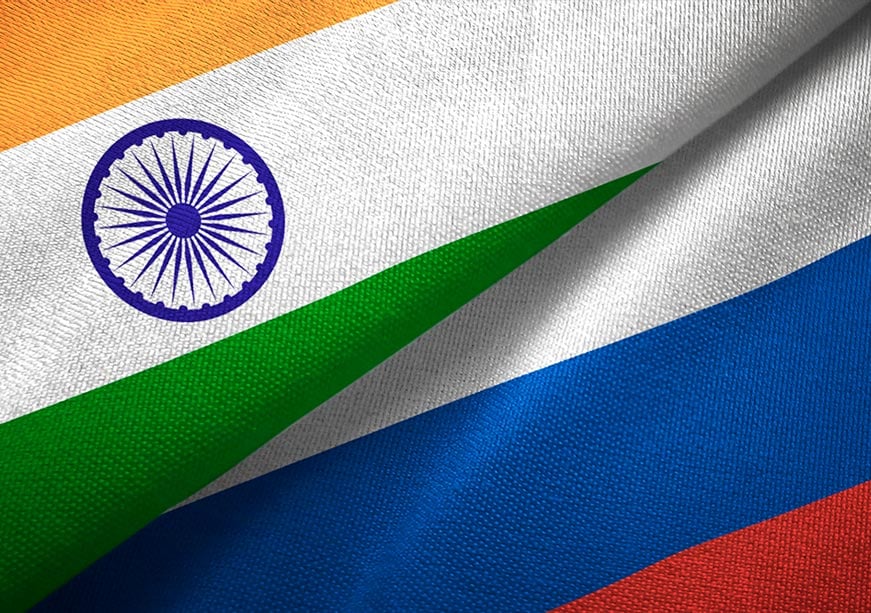
In August 2026, Russian Deputy Prime Minister Marat Khusnullin said Moscow should examine railway routes to the Indian Ocean and India, citing risks around the Bosphorus and Strait of Hormuz. He identified possible alignments through Turkmenistan, Iran, Afghanistan and, in some configurations, Pakistan, adding that “any options providing access to India are acceptable.” No route, cost or timeline has been confirmed. The proposal remains a trial balloon.
It should nevertheless be taken seriously because the pressure behind it is real and quantifiable. Hormuz carries roughly a quarter of global seaborne oil trade and close to a fifth of global LNG shipments, while recent disruption around Iran has made both Hormuz and the Bosphorus visibly less reliable for Russian and Indian commerce. Russian crude has simultaneously become central to Indian energy security, accounting for a record 55 percent of India’s crude imports in mid-2026 and making India Russia’s second-largest oil customer after China. Moscow has already tested one land alternative: in 2024, two trainloads of Russian coal reached India through the International North-South Transport Corridor (INSTC) and Iran. That was proof of concept, not yet a freight artery.
The commercial logic for an overland alternative is therefore not speculative. What is missing is a credible corridor. And India’s usefulness to that search, as well as its own interest in it, depends on more than diplomacy. It depends on whether India possesses, or is visibly building, the hydrological capability that could make a Pakistan-transiting corridor politically insurable.
Water, in other words, is the precondition for rail.
The Corridors Actually on the Table
Pakistan is neither the only nor the most advanced option. An Iran-anchored alternative already exists in partially built form. India has financed and is nearing completion of the 628-kilometre Chabahar-Zahedan railway, intended eventually to connect toward Mashhad and Serakhs on the Turkmenistan border. The 225-kilometre Khaf-Herat line linking Iran and Afghanistan is also nearing completion. Together, these projects provide an emerging INSTC backbone that bypasses Pakistan and therefore much of the India-Pakistan trust problem.
A second alignment runs through Central Asia and Pakistan. In July 2025, Pakistan, Uzbekistan and Afghanistan signed a trilateral agreement advancing the roughly 640-kilometre Trans-Afghan Railway, also known as PAKAFUZ or the Uzbekistan-Afghanistan-Pakistan railway. Russian and Uzbek transport ministries have since begun feasibility work on connecting it to a wider Eurasian network. Pakistan has separately promoted greater road and rail connectivity with Russia as a route to “warm waters.” This is the alignment closest to what Indian commentary generally means by a railway through Pakistan.
A third possibility may matter most strategically: Russia’s proposed connectivity could reportedly be integrated with CPEC infrastructure and Gwadar, with Chinese backing, “with or without Indian participation.” If that happens, India’s absence would not stop the corridor; it would leave China to shape a Eurasian rail architecture running through Pakistan while Indian trade remained dependent on maritime routes it does not control.
New Delhi therefore faces three plausible paths: deepen the Iran-anchored corridor it is already building; engage the Central Asia-Pakistan route Russia and Pakistan are advancing; or risk allowing a CPEC-integrated architecture to emerge without Indian participation. The second becomes genuinely attractive only if Pakistan becomes a sufficiently reliable transit partner.
There are also hard physical constraints. Russia and Central Asia use broad-gauge rail, while Iran uses standard gauge, creating bogie-change or transshipment requirements at multiple borders. Diplomacy cannot eliminate those costs. Nor can it eliminate the risks posed by Iran, Afghanistan or Pakistan. The question is which risks can be made manageable.
What the Indus Abeyance Has, and Has Not, Achieved
India placed the 1960 Indus Waters Treaty in abeyance after the April 2025 Pahalgam attack and reaffirmed that position in July 2026, conditioning its reversal on Pakistan credibly and irrevocably ending support for cross-border terrorism.
But abeyance is a political posture, not yet a hydrological fact. The treaty contains no unilateral suspension mechanism; Article XII provides for termination or modification through a treaty mutually ratified by both governments. Pakistan has consequently pursued the issue through the Permanent Court of Arbitration. In June 2025, the Court issued a supplemental award rejecting unilateral abeyance and reaffirming its jurisdiction. India rejected the ruling, calling the tribunal illegally constituted. In May 2026, the Court issued another award concerning “maximum pondage” at Indian hydroelectric projects on the western rivers, reportedly affirming substantive limits on India’s control under the treaty. India again rejected the award as null and void. Pakistan subsequently held a June 2026 conference in Islamabad focused on the treaty’s continuing legal validity.
Yet none of this has materially reduced water reaching Pakistan. India has accelerated work on western-river infrastructure, including the Chenab-Beas Link Tunnel and expansion of the Ranbir Canal, while halting hydrological data-sharing with Pakistan’s Indus Commissioner. But India’s existing storage and diversion capacity remains modest relative to the western rivers’ roughly 135 billion cubic metres of annual flow (which is roughly 80% of the system’s flow) to Pakistan. Pakistan’s military leadership has nevertheless treated the dispute seriously, with the July 2026 Corps Commanders Conference declaring institutional readiness.
The distinction is crucial. India’s abeyance was a defensible political response to terrorism, but it has remained principally an act of law and diplomacy, and on the treaty-law question, the argument currently favours Pakistan at The Hague. It is not yet an act of engineering. Leverage must exist physically before it can be spent diplomatically.
The Real Size of the Water Lever
Pakistan’s dependence makes water an unusually powerful potential instrument. Roughly three-quarters to four-fifths of its population lives within the Indus basin. Agriculture contributes almost 20% of GDP, generates more than 60 percent of foreign exchange earnings by some estimates, and the Indus Basin Irrigation System supplies roughly 90 percent of food production.
But “turn off the tap” is analytically misleading. Groundwater supplies more than half of Pakistan’s agricultural water and most domestic water use, supported by more than a million tubewells. That buffer is depleting and becoming increasingly saline, but it means upstream Indian action would not produce an immediate national cutoff. Its consequences would accumulate through reduced recharge and agricultural stress.
The more immediate constraint is India’s own capacity. The western rivers carry enormous volumes, most of which still reaches Pakistan regardless of treaty status. India’s storage and diversion infrastructure is only a small fraction of what would be required to substantially regulate that flow. On the eastern rivers, India has far less unused room: government estimates put utilisation of its allocation at around 95 percent, with projects such as Shahpurkandi capturing flows previously passing unused into Pakistan.
Consequently, any major increase in Indian leverage must come from the western rivers, the very basin where Himalayan terrain, seismic risk, treaty restrictions and adverse arbitration rulings make construction most difficult. The Central Water Commission estimates India’s share of Indus-basin average water-resource potential at roughly 73 billion cubic metres (BCM), of which perhaps 46 BCM is considered utilisable. That remains only a fraction of total system flow.
The conclusion is therefore balanced: India possesses potentially enormous leverage in what water means to Pakistan, but relatively little of that leverage is currently exercisable. Closing that gap is the policy task.
Restraint, China and the Brahmaputra
Two objections deserve careful treatment.
The first is that stronger Indian water policy will push Pakistan closer to China. But Pakistan-China coordination is already extensive. Chinese financing supports major Pakistani projects including Diamer-Bhasha and the planned Kalabagh dam, within a CPEC relationship that predates the current crisis by a decade. Pakistan has already sought greater Chinese involvement in the Indus dispute. What Indian conduct changes is less the existence of China-Pakistan cooperation than its political narrative. Beijing can amplify claims of Indian “water weaponisation” at little cost, particularly in international forums. India therefore needs legal and rhetorical discipline, especially before the Permanent Court of Arbitration, without confusing restraint in language with restraint in infrastructure.
The second argument is that Indian leverage over Pakistan could legitimise Chinese coercion over the Brahmaputra. The hydrology does not support a simple equivalence. Only roughly 14-35 percent of Brahmaputra annual flow originates in China, depending on the estimate; 65-86 percent is generated within India by rainfall and tributaries. The structural relationship is therefore almost the reverse of the Indus case.
China’s upstream position nevertheless matters. Beijing is constructing a proposed 60-gigawatt Yarlung Tsangpo hydropower complex reportedly costing about $137 billion. Even where upstream volume is a minority share, control over timing can matter through lean-season regulation, sediment retention or sudden releases. Residents have also reported unexplained Siang water-level drops. China previously stopped sharing hydrological data with India during the 2017 Doklam crisis before restoring it under a 2018 memorandum. The Expert-Level Mechanism on transboundary rivers, established in 2006, remains an important channel.
The honest restraint argument is therefore institutional, not volumetric. India needs norms protecting upstream development without crisis-time weaponisation of data or timing. That norm protects India against China more effectively than any claim of hydrological symmetry.
A Water-Connectivity Compact
The relationship between water and Russian connectivity is more subtle than using water to force Pakistan to permit transit. The logic runs in the opposite direction. A Pakistan facing a materially more capable India on the western rivers has greater reason to protect the economic value of transit, energy cooperation and Eurasian connectivity from disruption. That is what could make a Russian-financed Pakistan corridor insurable: not a threat at the negotiating table, but a changed incentive structure.
Moscow has a direct interest. The Chabahar-Khaf-Herat route carries lower India-Pakistan political risk, but depends on sanctioned Iran, Afghanistan’s limited rail infrastructure and gauge-transfer costs. The Central Asia-Pakistan route becomes more valuable if it can carry Russian-Indian trade as well as Russia-Pakistan traffic. And if Moscow defaults to a CPEC-integrated option shaped primarily by China, it accepts a corridor architecture designed around Chinese priorities, with India absent from its governance and financing.
Russia should therefore treat the Pakistan alignment as conditional rather than inevitable: a corridor worth serious investment once India-Pakistan relations acquire sufficient stability, and meanwhile a second-tier hedge behind the Iran-Afghanistan spine already being tested with real freight.
A viable compact would require transit rights insulated from ordinary bilateral disputes; third-party, including Russian, financial exposure large enough to make closure costly beyond the India-Pakistan relationship; automatic remedies for interruption rather than slow renegotiation; reciprocal enforceability, linking Pakistan’s desired water predictability to India’s need for transit predictability; and a visible, verifiable Indian infrastructure build-out so the leverage underpinning the arrangement is real rather than rhetorical.
Sequencing
None of this gives India an on-off switch over the Indus, nor should it seek one. River flows remain governed by glaciers, monsoons and climatic variability, and infrastructure designed principally for coercion would become a liability precisely during droughts and floods when cooperation matters most. The realistic objective is narrower: an India whose western-river capability is sufficiently substantial and visible that Pakistan’s rational calculation shifts from obstructing cooperation toward protecting its value, on water, energy and eventually Eurasian transit.
The sequence is therefore clear. Complete environmentally vetted storage, canal and monitoring projects within India’s treaty entitlements. Maintain legal and rhetorical discipline at the Permanent Court of Arbitration, where the procedural argument currently favours Pakistan. Continue investing in Chabahar and the INSTC as the primary lower-risk hedge. And only then bring a renegotiated water settlement and enforceable transit architecture to the table as linked instruments, once Indian capability, not merely its legal posture, has materially changed.
If a railway through Pakistan is ever built, it will not ultimately be secured by the language of treaty abeyance. It will be secured by canals, storage and monitoring systems that make India’s water entitlements real rather than merely declared, and by the discipline not to spend that capability rhetorically before it exists in concrete.
Dr. Yashwant Singh is a sociologist, recently served as an Assistant Professor in the Department of Sociology at GITAM (Deemed to be) University, Bengaluru, India. He holds an M.Phil. in Sociology from the University of Delhi and a Ph.D. in Sociology from the University of Hyderabad, India. His research interests include urban sociology, the sociology of development and geopolitics. His writings have appeared on several digital platforms, including Across Voices, Modern Diplomacy, Geostrategic Media, South Asia Journal, World Geostrategic Insights and IA-Forum.