 Douglas Vandergraph
The ninth high-level meeting between the Indian and Sri Lankan coast guards in Mirissa on 3 November 2026 was a useful diplomatic signal. Both sides identified search and rescue, maritime law enforcement, pollution response and technical cooperation as shared priorities. But the most persuasive test of this partnership will not be the number of meetings held. It will be what happens when a fishing vessel calls for help, its position is uncertain, its crew speaks a different language, and the nearest responders belong to another jurisdiction. India and Sri Lanka should turn their renewed cooperation into a jointly tested civilian-rescue protocol, with public results and fishermen involved in designing it.
This is not a proposal to erase maritime borders or excuse unlawful fishing. The Palk Strait is a place of real conflict over fishing methods, livelihoods and enforcement. A credible agreement must respect Sri Lanka’s fishing communities, including families whose livelihoods have suffered from bottom trawling, while protecting human life when an emergency arises. Rescue and accountability need not compete. In fact, mixing the two is one reason people may hesitate to report distress quickly. A first response can save lives without prejudging a later lawful investigation.
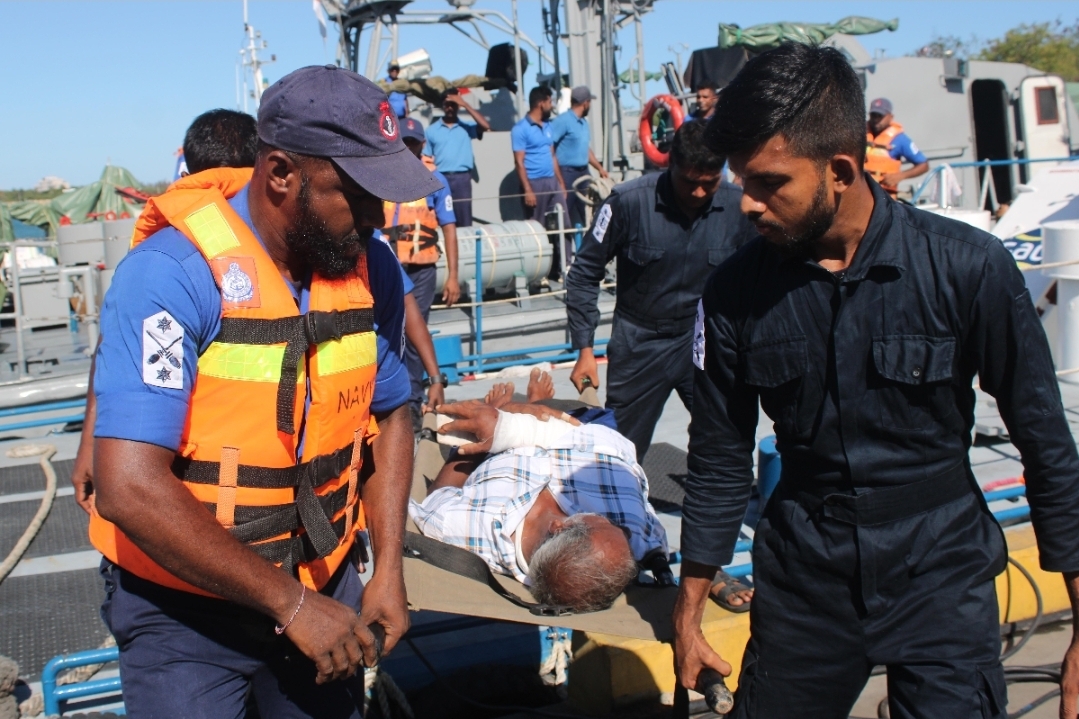
The distinction has already been demonstrated in practice. On 6 August, the Sri Lanka Navy reported rescuing eleven Indian fishermen after their trawler grounded south of Delft Island. Its report also said the vessel had crossed the maritime boundary and engaged in bottom trawling; the rescued fishermen and vessel were subsequently referred to police. Whatever the legal merits of a particular case, the sequence matters: first secure people in danger, then apply the law through an orderly process. Neither country should require its coast guard crews to make a political choice before making a lifesaving one.
The challenge is wider than crossings between India and Sri Lanka. On 2 November, Sri Lanka’s Navy described a joint operation after four fishermen from Kudawella failed to return. The Navy, Coast Guard, Air Force, Fisheries authorities and other fishing boats participated; another multiday trawler helped locate the crew approximately 200 nautical miles off the Pottuvil coastline. Four days later, the Navy reported bringing an injured and critically ill fisherman to treatment from the waters near Trincomalee. These accounts point to a practical truth: effective rescue depends on a chain of civilian reporting, coordination and response, not only a naval asset appearing at the end.
A bilateral protocol could therefore begin with a shared distress-reporting standard. Coast guards, fishing associations and fisheries departments should agree on the minimum information an initial caller must provide, how operators handle uncertain coordinates, and how a call crosses from one country’s rescue coordination centre to the other. Vessels without sophisticated equipment need a usable alternative to high-end digital tracking. A workable system should accept a radio message or relayed call from another boat, not only a location pin from a smartphone. Where language is a barrier, operators should have agreed Sinhala, Tamil and relevant regional-language scripts for confirming the same essential facts.
Second, the two coast guards should publish a clear separation between urgent assistance and fisheries enforcement. That would not mean an amnesty for alleged violations. It would mean transparent steps for receiving a distress call, establishing immediate medical needs, transferring survivors, preserving evidence and notifying families. Legal status and humanitarian status are different questions. Operational instructions should not leave those distinctions to improvisation in rough weather or at night.
Third, the countries should hold tabletop and at-sea exercises that involve fishermen rather than simply performing for observers. A useful scenario would start with a trawler that cannot transmit accurate coordinates, has a crew member needing urgent care, and drifts toward the boundary. Evaluators could record when the call was answered, when another authority was notified, whether a family received a verified update and whether the emergency referral worked. The after-action report should say which handoffs failed and what changed. A bilateral press statement that says cooperation was strengthened is not a substitute for evidence that the system improved.
Fourth, the protocol must include the people who will live with its weaknesses. Fishermen’s associations from northern Sri Lanka, counterparts across the Palk Strait, maritime emergency doctors and relatives of missing crews can test whether the instructions make sense. The public should not be asked to share precise vessel positions or personally identifying case files. But aggregated figures—such as median acknowledgement times, unresolved coordination failures and follow-up on recommended fixes—could be released without compromising legitimate operational security. The purpose is to make rescue more accountable, not to create another surveillance burden on small boats.
A reasonable objection is that this proposal places humanitarian issues ahead of sovereignty. It does not. A state with respected borders also needs clear rules for emergencies at those borders. Another objection is that rescue coordination already exists, and Sri Lankan authorities have demonstrated considerable ability. That is true and worth recognizing. The Colombo Maritime Rescue Coordination Centre and joint operations are evidence of capacity, not evidence that no improvement is possible. Strong institutions are strengthened when they measure their performance against difficult cases, including those that expose confusion or delays.
For me, the Christian reason to care is not that maritime law can be replaced by a religious parable. It cannot. It is that the Good Samaritan in Luke 10 refuses to make the injured stranger wait for agreement on who owes him care. The lesson is about responsibility becoming action. A Sri Lankan or Indian reader need not share that belief to recognize its civic implication: there should be a dependable response for the person in danger, even where governments dispute other matters intensely.
The immediate next step is modest. Before the next bilateral high-level meeting, the two coast guards could designate a small joint civilian-rescue working group, include fisheries representatives from both sides, and publish the terms of reference for one pilot exercise and a brief after-action summary. That would not settle the fishing dispute. It would accomplish something narrower and urgently necessary: make it more likely that the next distress call receives a response designed in advance, not negotiated while a boat is sinking. That is an Indian Ocean partnership worth measuring.
Douglas Vandergraph is a Christian writer, Bible teacher, podcaster, and digital creator based in Fort Collins, Colorado, whose work centres on Jesus Christ, Scripture, spiritual growth, practical encouragement, and long-form Bible study. Douglas writes and speaks to help people connect the teachings of Jesus with grief, prayer, forgiveness, perseverance, purpose, hope, and everyday life.
Sources for editorial verification
Government of India, Ministry of Defence, “Indian Coast Guard and Sri Lanka Coast Guard Hold 9th High-Level Meeting,” 3 November 2026. https://www.pib.gov.in/PressReleasePage.aspx?PRID=2332184&lang=1®=1
Sri Lanka Navy, “Navy Rescues 11 Fishermen from Indian Trawler Ran Aground off the Delft Island,” 6 August 2026. https://news.navy.lk/operations-news/2026/august/navy-rescues-11-fishermen-from-indian-trawler-ran-aground-off-the-delft-island.html
Sri Lanka Navy, “Navy Renders Assistance in Bringing Ashore 4 Stranded Kudawella Fishermen,” 2 November 2026. https://news.navy.lk/operations-news/2026/november/navy-brings-ashore-4-stranded-kudawella-fishermen-at-sea.html
Sri Lanka Navy, “Navy Brings Ailing Fisherman Ashore for Urgent Treatment,” 6 November 2026. https://news.navy.lk/operations-news/2026/november/navy-brings-ailing-fisherman-ashore-for-urgent-treatment.html
Luke 10:25–37 (Good Samaritan).

 Patrick Omam