 Dr. Yashwant Singh
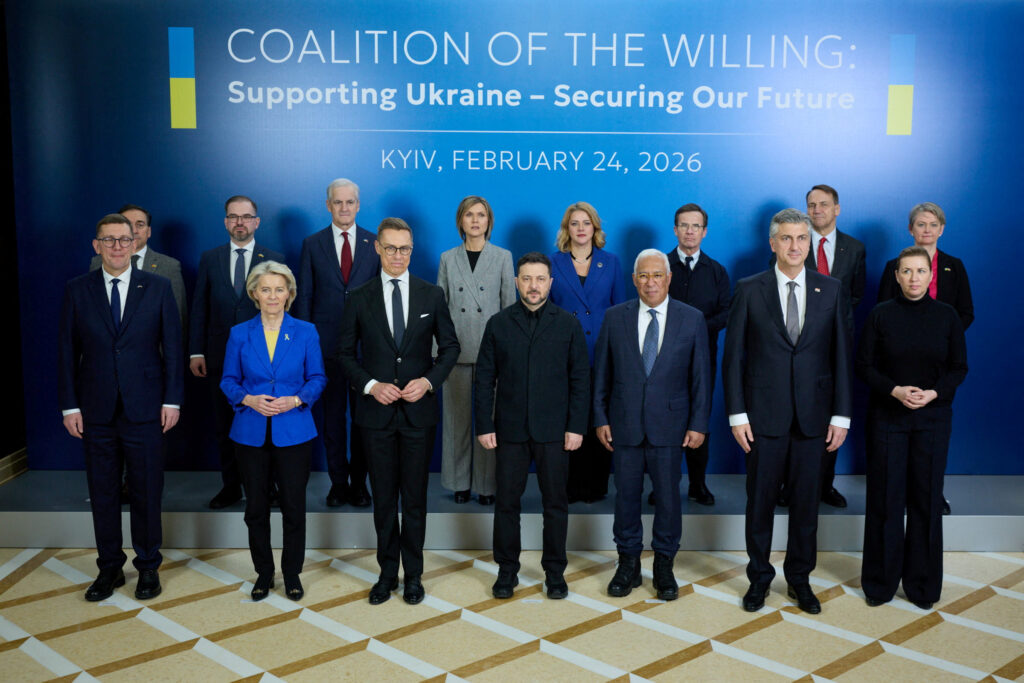
Did Europe sacrifice its leverage for security, or its security for a seat it never needed? The answer will come not from the commentators, but from the Ukraine settlement now being drafted, and from whether Europe is in the room when the pen touches the paper.
On February 01, 1970, with the Cold War at its coldest, West Germany signed a deal to buy Soviet gas in exchange for steel pipe. Washington was uneasy. Moscow was hostile. Europe did it anyway. For half a century the pipes outlived the Berlin Wall, the Soviet Union, two Chechen wars, the annexation of Crimea. Molotov cocktails and missile crises came and went, and the gas kept flowing. Whatever else it was, the arrangement was a rope tying two enemies together, and ropes work both ways.
In 2022, Europe took out a knife.
The wager
The logic was seductive. Europe was the world’s richest customer. Russia was a petro-state with a nominal GDP (2021) smaller than Italy’s. Surely the customer, armed with the City of London, Euroclear and the insurance market, held the leash. Cut the revenue, starve the war, watch Moscow blink.
Moscow did not blink. It rerouted. Tankers sailed east, grey fleets multiplied, India turned into a refinery for Russian crude and a seller of diesel back to Europe, and the price cap, which governed Western services rather than Russian sales, turned out to be a fence around a field the horse had already left. The weapon was designed for a victim with nowhere to run. Russia had a map.
The one-way door
Then came the move that sceptics find truly remarkable. Europe did not merely suspend Russian gas. It legislated its death. On January 26, 2026 the EU adopted Regulation 2026/261, a legally binding phase-out with full application by September 30, 2027. Russian gas still made up roughly 12% of EU imports in 2025, and the EU was buying around 76.1% of the output of Russia’s Arctic Yamal LNG project. Europe was the anchor customer of the very machine it was switching off.
Consider what that means in negotiating terms. A sanction you can lift is currency. A statute that forecloses the trade is a burned bridge, and burned bridges buy nothing at the bargaining table. Europe took its single most valuable chip, the promise of normal commerce after peace, and welded it to the floor. Moscow need only wait.
Meanwhile the old arteries were closing. The Ukrainian transit route had already ended. Nord Stream lay ruptured on the Baltic seabed, its destruction in September 2022 never resolved to anyone’s satisfaction. The pipes that had survived the 20th century did not survive the 21st.
The mirror in Abu Dhabi
Now the scene shifts to the Gulf. US envoys Steve Witkoff and Jared Kushner shuttle between delegations. Then President Zelenskyy discloses that Washington has raised the idea of Ukraine withdrawing from Donbas in exchange for NATO membership.
Scrupulously, this is not a deal. Zelenskyy himself said the question had been raised for the first time but no concrete offer existed. Kyiv, he stressed, is unwilling to retreat from its territory, and any such step would go to a referendum only with a full security package.
But read the details that matter. The question links territory to alliance membership, which is a Russian framing of the war’s meaning that Europe has refused for four years. And look at who was in the room. European delegates, representing Ukraine’s largest financial and military backer, talked with US and Ukrainian officials but did not sit at the table with Russia.
The paymaster was in the lobby.
Yalta’s shadow
European history has a name for this feeling. In February 1945, three men sat in Crimea and drew lines across a continent whose peoples were not in the room. Poland learned its future by telegram. Sceptics will not say Abu Dhabi is Yalta. They will say the reflex is the same: great powers, bilateral logic, small states as variables.
And the irony cuts deeper. Europe’s founding project was designed so that this could never happen again. Its answer to Yalta was to build an economic union too entangled to be carved up. Now, they argue, it has dismantled the entanglement with its nearest neighbour while remaining militarily dependent on a distant protector whose attention is global, whose patience is finite, and whose political calendar is not European.
Substitution, not liberation
The promised prize was autonomy. The balance sheet reads differently. Pipeline gas from one authoritarian neighbour has been replaced by LNG from American and Gulf suppliers. Industrial users such as chemicals, fertilisers, glass and metals face a choice between thin margins, higher prices and moving abroad, and factories that leave do not return. Energy is not the sole cause of European stagnation; demography, regulation and technology gaps are real. But a continent already short of growth chose to make its power more expensive than its competitors’, in the middle of the largest industrial race in a century.
The result, the critics say, is a peculiar kind of triumph: Russia pushed towards Beijing, Europe pushed towards Washington, and the old Eurasian middle left without a hinge.
What the pipes were for
Trade does not stop wars. February 2022 proved it. But pipes create something subtler than peace: channels. Engineers who call each other. Contracts that need renegotiating. Ministries that must talk when everything else has gone quiet. When Willy Brandt chose Ostpolitik, he was not buying friendship. He was buying the telephone line.
Europe has traded the telephone line for the moral high ground. The high ground is real. It is also, sceptics note, a poor place from which to dictate terms.
Counterarguments and the road ahead
Defenders of the policy answer that the rope was never neutral. Russia manipulated gas supplies in the months before the invasion, which suggests dependence invited coercion rather than deterring it. They point out that Europe absorbed the shock far better than forecasts predicted, while Russia runs a war economy with discounted exports, a narrower buyer base and growing reliance on Beijing. Keeping Russian gas as a future bargaining chip, they add, would also keep Europe’s throat in reach of the next ultimatum. And Europe’s absence from Abu Dhabi reflects military capacity, which no energy policy was ever meant to supply. It still holds real cards: financing, frozen assets, sanctions architecture, reconstruction capital and any role in guarantees. The Donbas question, finally, is unconfirmed, contested and possibly a probe.
Which brings the argument to its core. Strategic separation from Russia is not the same as strategic independence. Europe has achieved the first at considerable cost and the second only partially. Whether the investment yields a more secure continent will depend less on the sanctions already imposed than on whether Europe can translate its financial weight and political commitments into a decisive role in shaping the settlement now taking form.
Author’s Bio: Dr. Yashwant Singh is an Indian sociologist working at the intersection of urban studies, development, nature and geopolitics. He holds an M.Phil. in Sociology from the University of Delhi and a Ph.D. from the University of Hyderabad, and recently served as Assistant Professor of Sociology at GITAM (Deemed to be) University, Bengaluru. His essays and analyses have been published across several international platforms, including Across Voices, Modern Diplomacy, Eurasia Review, Jerusalem Strategic Tribune, Geostrategic Media, South Asia Journal, World Geostrategic Insights, and IA-Forum.