
 Dr. Yashwant Singh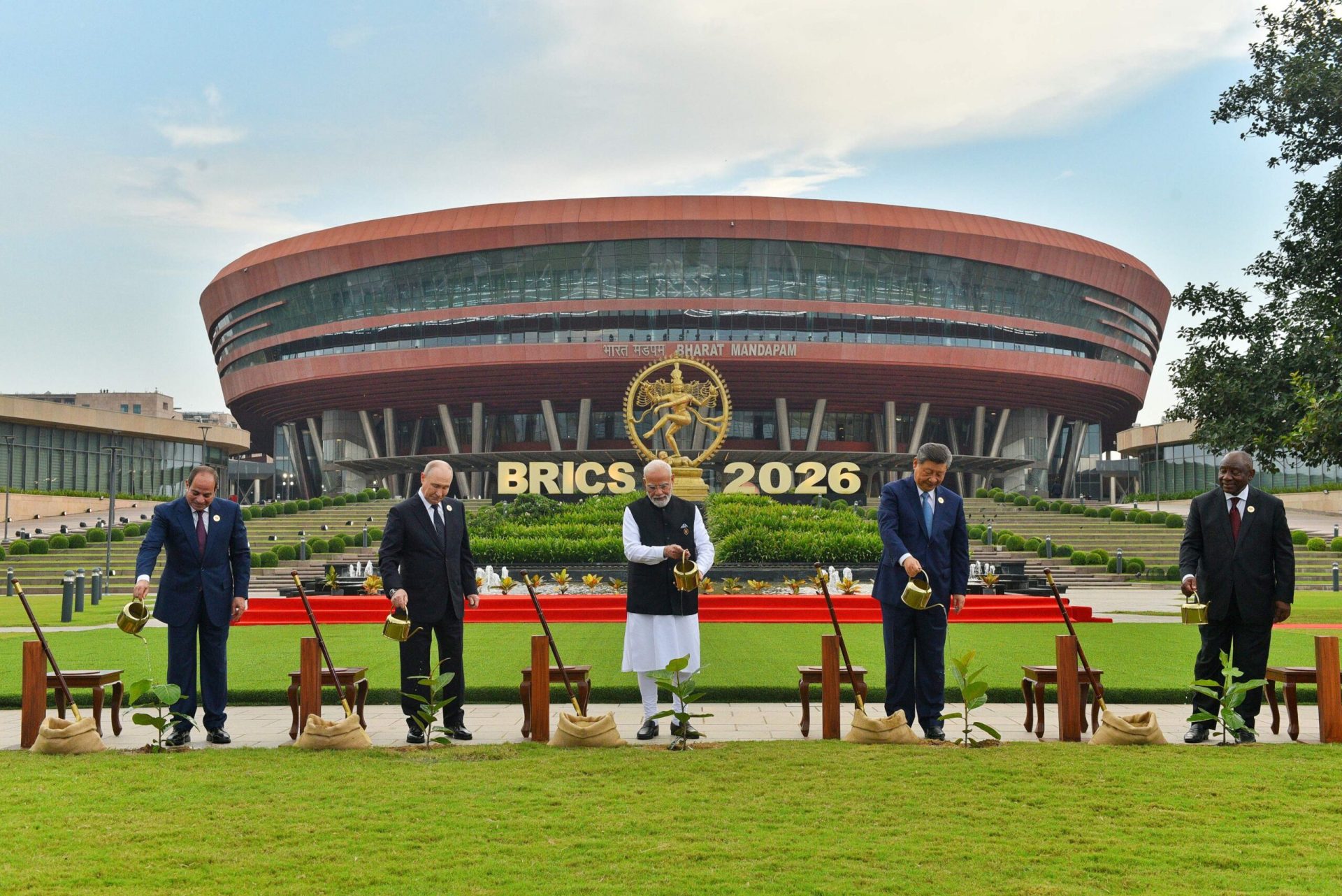
Most commentary judges BRICS by the familiar frame: de-dollarization, anti-Western bloc; the more consequential story emerging from the 18th BRICS Summit’s New Delhi Declaration (September 12, 2026) is infrastructural: a sovereignty-preserving, non-binding lattice of payment rails, cables, satellites, reserve funds, and standards bodies that functions as redundant plumbing for the Global South rather than a rival to the UN/Bretton Woods order it still explicitly seeks to reform from within.
The New Delhi Declaration’s 140 paragraphs are not primarily a statement of geopolitical intent; they are closer to a bureaucratic inventory, an audit of some seventy working groups, task forces, alliances, networks, hubs, forums and compendia that have been quietly assembled since 2015 and are now, in 2026, beginning to interlock. Read this way, the Declaration is less a manifesto than a municipal ledger for a city that has been under construction for two decades and has just crossed the threshold from settlement to administration. The real story of 2026 is not confrontation with the Bretton Woods order; it is the maturation of a second, parallel operating system for global governance, one built by accretion, not revolution, and designed explicitly to avoid triggering the kind of systemic rupture that would justify Western containment.
From summit diplomacy to permanent bureaucracy
The single most underappreciated fact in the Declaration is quantitative: over four hundred ministerial, official and expert-level meetings across thirty Indian cities in a single chairship year (para. 6). No bloc assembles that density of technical machinery, covering customs, tax, standards, statistics, pensions, competition law, intellectual property, supreme audit institutions, nuclear medicine, and sports goods manufacturing, merely to make a symbolic point about multipolarity. This is the signature of what integration theorists once called functionalism: the Mitranian wager that political convergence follows technical convergence, not the reverse. As David Mitrany (1943) writes, “The beginnings cannot be anything but experimental” (A Working Peace System, page.7). What is striking is that BRICS is running the functionalist playbook in a mode the European Community never used: radically decentralized, deliberately non-binding, and allergic to supranational delegation. Nearly every substantive paragraph is fenced with the words “voluntary,” “non-binding,” “in accordance with national circumstances” or “member-driven.” This is not weakness; it is design. BRICS has concluded that the fastest way to build durable Global South infrastructure is to strip out the sovereignty costs that doomed comparable projects (the Non-Aligned Movement’s institutional thinness, the G77’s perpetual underfunding) and to substitute a lattice of opt-in technical secretariats that any member can join, ignore, or partially adopt without cost. It is sovereignty-preserving integration, a “network state” model rather than a treaty organization.
The financial scaffolding is more advanced than the dollar debate admits
Western commentary fixates on de-dollarization rhetoric that is, in fact, almost entirely absent from this text. What is present is more consequential: a Payment Task Force studying interoperable cross-border messaging (para. 90), a nascent BRICS insurance and reinsurance ecosystem including a proposed Risk Lab at GIFT City (para. 92), a New Investment Platform under active technical design (para. 93), exploratory work on shared settlement and depositary infrastructure (para. 94), a Multilateral Guarantees initiative to de-risk private capital for Global South infrastructure (para. 102), and a Contingent Reserve Arrangement being restructured for faster crisis response with new members queued to join (para. 97). None of this is a challenge to the dollar system. All of it is a hedge against exclusion from it: a redundant financial plumbing system built for the day a member is sanctioned, frozen out of SWIFT, or denied IMF quota share commensurate with its GDP. The strategic logic is insurance, not insurrection. Notably, the Declaration pairs every one of these initiatives with reaffirmed calls for IMF and World Bank quota reform (paras. 17-19), a “voice and access” strategy aimed at reforming the existing system while simultaneously building a lifeboat, rather than a “exit and replace” strategy aimed at sinking it.
Digital and physical infrastructure sovereignty is the real frontier
The submarine cable feasibility study (para. 74), the Digital Public Infrastructure repository and pilot projects (para. 77), the Remote Sensing Satellite Constellation (para. 45), and the AI governance statement paired with an explicit commitment to “energy efficiency of AI systems” and “trustworthy AI technologies” tailored to Global South needs (para. 81) together describe something more ambitious than payments diversification: an attempt to own the physical and data layer of connectivity so that Global South digital sovereignty does not depend on cables, clouds, or model weights controlled elsewhere. This is the domain where BRICS’s institutional patience is most likely to compound into durable strategic leverage over the next decade, precisely because undersea cables and satellite constellations are capital-intensive, slow-moving infrastructure that, once built, are extremely difficult to dislodge or duplicate. A BRICS grain exchange (para. 60), a critical minerals framework (para. 67), and an MSME credit-assessment architecture (para. 85) round out a picture of a bloc quietly assembling substitutes for the commodity, credit, and connectivity chokepoints through which the existing order has historically exercised leverage over developing economies.
The UN language is a deliberate act of institutional loyalty, not dissent
It would be easy to read paragraphs 7-14, reform of the Security Council, the Secretariat, the Bretton Woods institutions, as revisionist. The more precise reading is that BRICS has positioned itself as the loyal opposition of the liberal international order: it wants a bigger seat at the table it already sits at, not a different table. The explicit reaffirmation that China and Russia support Indian and Brazilian Security Council ambitions (para. 13), carried over verbatim from the Beijing and Johannesburg declarations, functions as a standing IOU that keeps two of the bloc’s most consequential members, India and Brazil, both hedging powers with deep Western ties, institutionally tethered to the BRICS project even as they resist any characterization of it as anti-Western. This internal hedging logic, more than any external adversary, is what disciplines the document’s tone throughout: it must be strong enough to be useful to Beijing and Moscow’s systemic critique of Western primacy, while remaining anodyne enough that New Delhi and Brasília can sign it without complicating their Washington and Brussels relationships. The result is a text that reads, paragraph by paragraph, like a controlled experiment in how much institutional ambition an 11-members’ group with genuinely divergent grand strategies can sustain without fracturing.
The Global South’s grievance portfolio is being consolidated, not just voiced
Gaza, Sudan, Syria, Lebanon, Cuba, colonialism, the Middle East nuclear-free zone, unilateral coercive measures: the Declaration’s political sections function as an accumulating docket of Global South grievances against the enforcement asymmetries of the current order (who gets sanctioned, whose ceasefires hold, whose infrastructure is protected). What is new in 2026 is the explicit linkage of this grievance docket to the institutional scaffolding described above: the same document that condemns unilateral sanctions (para. 22) is building an insurance ecosystem, a reserve arrangement, and a payments system designed to reduce vulnerability to exactly those sanctions. The moral register and the technical register are no longer separate tracks; they are being fused into a single coherent theory of self-defense.
The synthesis
The 2026 Declaration should be read as evidence that BRICS has passed from an era of declaratory multipolarity into an era of infrastructural multipolarity. The bloc is not building a rival UN, a rival IMF, or a rival dollar. It is building rival plumbing (payment rails, cables, satellites, reserve funds, credit-assessment tools, standards bodies) that can be activated selectively, by any subset of members, whenever the existing plumbing fails them, without ever requiring a formal break. This is a strategy optimized for a world of uncertain American commitment and volatile sanctions regimes: cheap to build, hard to sanction, deniable as confrontation, and compounding in value the longer it operates unremarked. For institutions accustomed to judging BRICS by its communiqué rhetoric, the more urgent analytical task is now to track its balance sheets, its cable maps, and its working-group calendars, because that is where the emerging Global South governance architecture is actually being poured in concrete.
 Dr. Yashwant Singh