 Dr. Yashwant Singh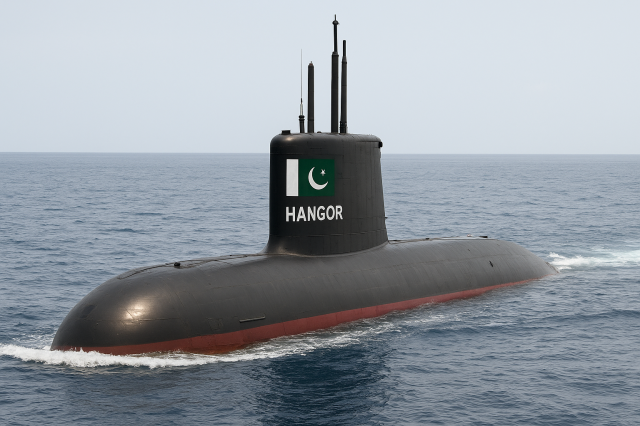
Pakistan’s navy crossed a real threshold in 2026. The headline event, a submarine commissioning in China, is the least interesting part of the story. The more consequential one is a request Pakistan reportedly made and China reportedly refused.
On 30 April 2026, Pakistan commissioned PNS Hangor at a ceremony in Sanya, China, attended by President Asif Ali Zardari and naval chief Admiral Naveed Ashraf. It is the lead boat of an eight-submarine class built jointly by Chinese and Pakistani shipyards, under a roughly $5 billion deal signed in 2015. The submarine reached Karachi on 11 June 2026 after its delivery voyage.
The Hangor is conventionally powered, air-independent-propulsion (AIP) technology, derived from the PLAN’s Type 039A/B Yuan-class, not nuclear-powered. Pakistani naval planning treats the conventional fleet as an anti-ship and anti-submarine asset; any future sea-based nuclear deterrent is expected to run through a separate, dedicated platform.
Four more Hangors are under construction in China, four more at Karachi Shipyard. All eight are expected in service by 2028. Once older Agosta-class boats and midget submarines are counted, Pakistan’s combined underwater fleet reaches roughly sixteen boats.
The Story Beneath the Story
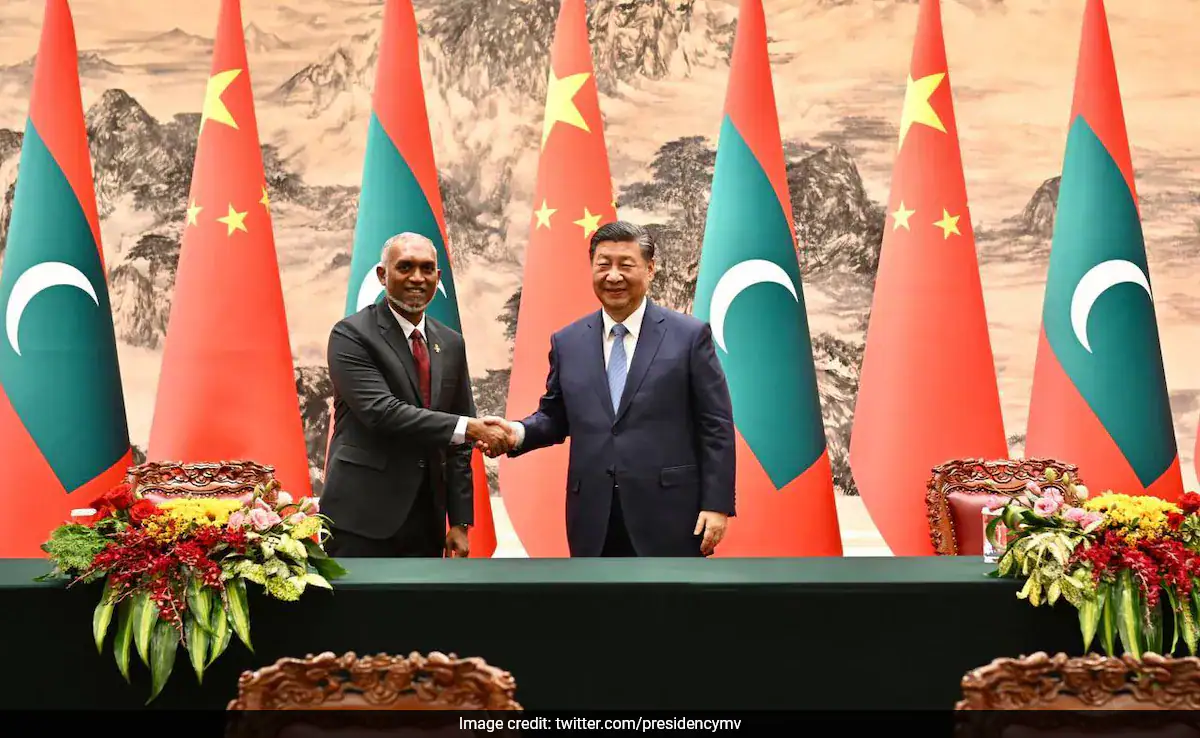
In May 2026, Drop Site News reported on leaked cables alleging Pakistan had directly asked China for help acquiring a sea-based nuclear second-strike capability, reportedly raised during bilateral talks over a potential Chinese military base at Gwadar. Pakistan is said to have offered China a permanent military facility there in exchange. China reportedly declined, citing its own non-proliferation commitments and the strategic exposure such a transfer would create for Beijing itself.
This remains well-sourced but unofficial reporting, neither government has confirmed it.
Why the distinction matters: a dedicated nuclear-armed submarine is not an incremental upgrade. It hands its owner a survivable second-strike deterrent, in a way a conventional boat, however capable, cannot, since conventional submarines remain vulnerable to detection and preemption. Analysts covering the episode have drawn this same line: what Pakistan reportedly sought looked less like modernization and more like a long-term restructuring of its nuclear force posture.
What China’s Refusal Actually Tells Us
Beijing has sold Pakistan an entire modern submarine fleet, aircraft, and missile systems without hesitation. It was reportedly not willing to hand over the one capability that would make Pakistan’s deterrent unconditionally survivable, even against the offer of a permanent naval foothold at Gwadar, something China has sought for years.
That’s a strong signal China draws a sharp, transactional line: arms transfers that deepen an existing rivalry are one thing; a transfer that would rewrite the region’s nuclear geometry is another.
The Conventional Balance Is Still Shifting
None of this makes the underwater balance in the Arabian Sea static. It’s moving quickly, just along the conventional axis. The Hangor program compresses what would otherwise be a decades-long indigenous submarine effort into roughly ten years. Per open-source assessment, it also gives Pakistan the nuclear-capable Babur-3 submarine-launched cruise missile as part of its loadout, a system Islamabad first tested in 2017, well before the Gwadar talks reportedly took place.
Even without a dedicated SSBN, that’s a real deterrence upgrade: a survivable, dispersible cruise-missile submarine fleet complicates India’s targeting problem in ways the older Agosta fleet never did.
India’s Two-Track Response
Track one, the nuclear leg, is on its own timeline and unthreatened. Navy Chief Admiral Dinesh K. Tripathi has confirmed a new indigenous nuclear-powered ballistic-missile submarine will be commissioned soon. INS Aridhaman (the S4-class) is expected to join the already-operational Arihant-class, the sea leg of India’s nuclear triad, a capability Pakistan’s conventional fleet cannot touch regardless of Chinese assistance.
Track two, conventional replacement, is where the picture looks worse. Project 75-I, six AIP submarines to be built with Germany’s ThyssenKrupp Marine Systems, remains stuck in negotiation nearly three decades after conception, even as Pakistan has already begun inducting comparable Chinese-built boats. Cost estimates have climbed from roughly Rs.43,000 crore in 2018 to around Rs.70,000 crore by 2026, with the first Indian boat unlikely before the early 2030s even on an optimistic timeline.
The fleet arithmetic is blunt: India operates around sixteen conventional submarines today, a number set to shrink as older boats retire, against a Pakistani fleet trending toward sixteen of its own by 2028, despite India needing a far larger, more dispersed force to cover a coastline many times longer than Pakistan’s.
The Bottom Line
There’s no evidence China has proliferated a nuclear-armed submarine to Pakistan, and the best available reporting suggests Beijing explicitly declined to, even when offered a significant strategic inducement. What China has delivered instead is a substantial conventional submarine fleet that meaningfully narrows the underwater gap with India, pushing New Delhi into a familiar bind: racing to close a capability gap through a procurement process that keeps moving slower than Islamabad’s Chinese-backed one, even as India’s actual nuclear deterrent develops on a separate track that Pakistan’s conventional buildup barely touches.
The real finding here isn’t what China gave Pakistan. It’s what China withheld, and why. The nonproliferation threshold has reportedly been tested once, under real pressure, with a real inducement on the table, and it held. Whether it holds under a sharper crisis, a shift in Pakistan’s independent nuclear efforts, or a change in Beijing’s own calculus is the open question worth watching.
Note: The claim that Pakistan sought sea-based nuclear assistance from China, and that China refused, rests on Drop Site News reporting based on leaked cables. It has not been officially confirmed by either government.
Dr. Yashwant Singh is a sociologist, recently served as an Assistant Professor in the Department of Sociology at GITAM (Deemed to be) University, Bengaluru, India. He holds an M.Phil. in Sociology from the University of Delhi and a Ph.D. in Sociology from the University of Hyderabad, India. His research interests include urban sociology, the sociology of development and geopolitics. His writings have appeared on several digital platforms, including Across Voices, Modern Diplomacy, Geostrategic Media, South Asia Journal, World Geostrategic Insights and IA-Forum.