
 Dr. Jalal Selmi
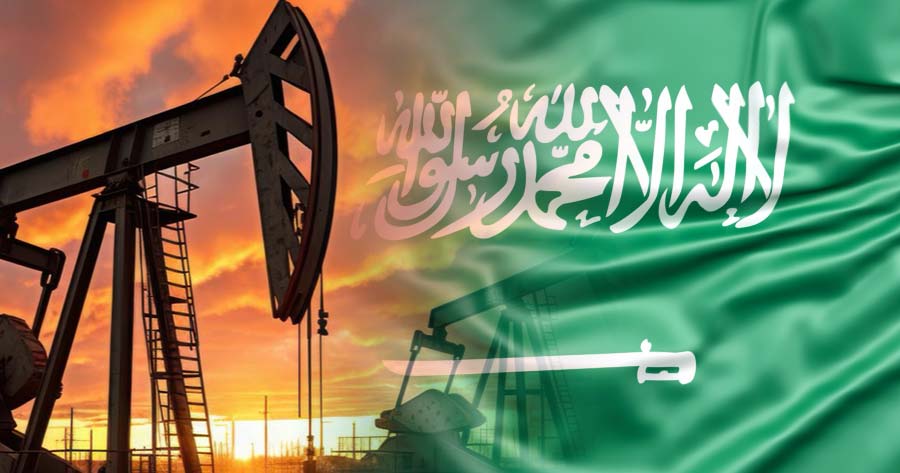
Energy stability depends on more than supply and demand. It can also be threatened when a producer uses oil to gain political influence. Disruptions to shipping, economic downturns, and geopolitical conflicts can all affect energy markets. But one of the strongest tools available to a producer is cutting output to push prices higher.
As of this writing, Riyadh has offered no concrete signal that it intends to weaponize its energy exports for strategic ends. Still, the question stands: Does Saudi Arabia use energy as a political tool? And if it wished to, could it?
Saudi Arabia’s Past Use of Oil
The 1973 oil crisis (the “first oil shock”) marks the most prominent beginning of Riyadh’s historical record in this field. On 15 October 1973, the Organization of Arab Petroleum Exporting Countries (OAPEC)—comprising the Arab members of OPEC plus Egypt and Syria—announced an oil embargo against Western states, specifically the United States and the Netherlands, aiming to push them to force Israel to withdraw from the Arab territories occupied in the 1967 war.
This crisis was the clearest example of employing energy as a political tool. It was one of the fundamental causes of the great recession that struck the global economy between 1973 and 1974, and the rise in oil prices continued until 1986. Its impact was amplified by the collapse of the Bretton Woods system in 1971, when U.S. President Richard Nixon suspended the convertibility of the dollar into gold.
The embargo ended in March 1974 after American diplomatic efforts led by Secretary of State Henry Kissinger. These efforts included U.S. pressure on Israel to sign disengagement agreements with Egypt (January 1974) and Syria (May 1974), alongside a November 1973 European Economic Community statement that, for the first time, aligned more closely with the Arab interpretation of Resolution 242. The episode demonstrated that energy could be used to extract concrete diplomatic concessions.
The transition from King Faisal to King Khalid in 1975 illustrated how a change of monarch could produce a distinct shift in energy policy, even while certain core orientations—such as the continued dollarization of oil exports—were preserved. King Khalid opposed sudden price rises, adhering to the idea of “the singularity of the outcome in the global economy” (that global recession affects the stability of all states, producers and consumers alike). At the 1976 Doha meeting he opposed the desire of OPEC members to raise prices and instead increased oil pumping in a tangible manner afterward. Since the era of King Khalid, Riyadh has entrenched the principle that “oil is an economic commodity, not a weapon.” The fundamental point of agreement between the policies of Kings Faisal and Khalid was Khalid’s continuation of the dollarization of energy exports that had begun in the final months of Faisal’s rule.
With Cairo’s signing of a peace agreement with Tel Aviv in 1979, a weighty regional Arab state exited the scope of Arab cohesion in decision-making. This was followed by the threat perceived by the Arab Gulf states from the Islamic Iranian Revolution due to geographical proximity, the invasion of Kuwait by Iraqi forces under Saddam in 1990, the resort of the Gulf states to American forces whose bases spread throughout the Gulf, and the collapse of the Soviet Union, which led to the emergence of a unipolar system.
Motives of Riyadh toward Employing Energy as a Political Tool
In 2025, Saudi Arabia’s oil exports reached 2.35 billion barrels, confirming its position as the world’s leading primary oil exporter—a status held since 1974. Several motives could currently be read as drivers for Riyadh to employ energy as a political tool: Confronting Houthi and Iranian threats amid direct targeting of the Kingdom, and its need for regional and international alliances, as production cuts could pressure other states to build defensive systems for it.
Financing Vision 2030, aimed at greater economic independence by reducing oil dependence as the main GDP source, which sometimes leads it to cut production to support prices.
Strengthening its status as an influential regional power, especially after the UAE’s sudden withdrawal from OPEC on 28 April 2026 over disagreements on Yemen and export quotas. Abu Dhabi sought to raise output to 4.85 million barrels per day free of OPEC limits, alongside the erosion of Riyadh’s diplomatic prestige from repeated Houthi and Iranian attacks.
These factors suggest that Riyadh might cut oil production to encourage other countries to provide security support. However, they do not prove that this is its intention.
Limits on Using Oil as a Weapon
Despite these motives, the official Saudi position was clear in Investment Minister Khalid Al-Falih’s November 2023 statement that oil is not used as a political lever by Saudi Arabia. A further confirmation came from Energy Minister Abdulaziz bin Salman on 12 October 2026, who said the Kingdom’s goal is for “Riyadh to be the capital of global energy security.”
These statements are clear, yet tangible obstacles prevent Riyadh from using energy as an absolute political weapon today:
– The political orientation set by King Faisal—despite the 1973 embargo—and later consolidated under Kings Khalid and especially Fahd gradually tied Saudi decision-making more closely to Washington in the political, economic, military, and security spheres, culminating in the 1990–91 Gulf crisis. A dense web of interests emerged that is difficult to unwind. After the signing of the Joint Commission on Economic Cooperation on 8 June 1974, U.S. Treasury Secretary William Simon visited Jeddah in July 1974 and negotiated a discreet arrangement that allowed Saudi Arabia to invest a substantial share of its oil surpluses in U.S. Treasury securities (kept secret at King Faisal’s request). This arrangement accelerated the recycling of petrodollars and deepened Saudi financial interdependence with the United States, without constituting a formal treaty obliging Riyadh to price oil exclusively in dollars. The resulting entanglement constrained Riyadh’s freedom of maneuver: any abrupt production cut aimed at political ends would risk damaging its own financial interests and triggering a firm response from Washington. In Goetschel’s terms, Saudi influence in this domain became more constrained (negative power) than autonomous (positive power).
– The international reputation Riyadh built after 1974 as a global economic safety valve. Sudden price rises via production cuts would damage its image as a reliable supplier and hurt its economy amid today’s independent alternatives.
– In today’s unipolar order dominated by Washington, the space for Saudi Arabia to use energy as unilateral political leverage is significantly narrower than in 1973.
– The Iran-U.S. war and the subsequent flare-up in the Red Sea reaching into Saudi territory. Engagement with the Houthis could backfire due to shortages of military equipment needed for fully independent self-defence.
– Saudi Arabia’s need to preserve balanced ties with Pakistan, Turkey, Egypt, and major powers such as the U.S. and UK limits its willingness to risk abrupt oil-price shocks that could damage these relationships.
– The recent UAE withdrawal from OPEC and Qatar’s earlier exit (in 2026). These states might use energy exports to gain global trust if Riyadh acted, while OPEC members could distance themselves from abrupt Saudi policies.
– The recent U.S.-Russian understanding, reflected in Washington’s temporary exemption and sanctions relief for Russia’s energy sector, shows that under high demand, political use of energy favors pumping more oil rather than cutting it. This reinforces that such a tool is largely reserved for economically and militarily stronger actors, not for states under direct nearby threats such as Saudi Arabia.
Under these structural and political constraints, a full Saudi oil embargo remains highly improbable. However, Riyadh’s practice of taking timed precautionary measures to stabilize its financial income while cautiously encouraging certain parties to provide security, military, and diplomatic support has continued for years and will persist without sudden change.
 Dr. Yashwant Singh