
 Dr. Yashwant Singh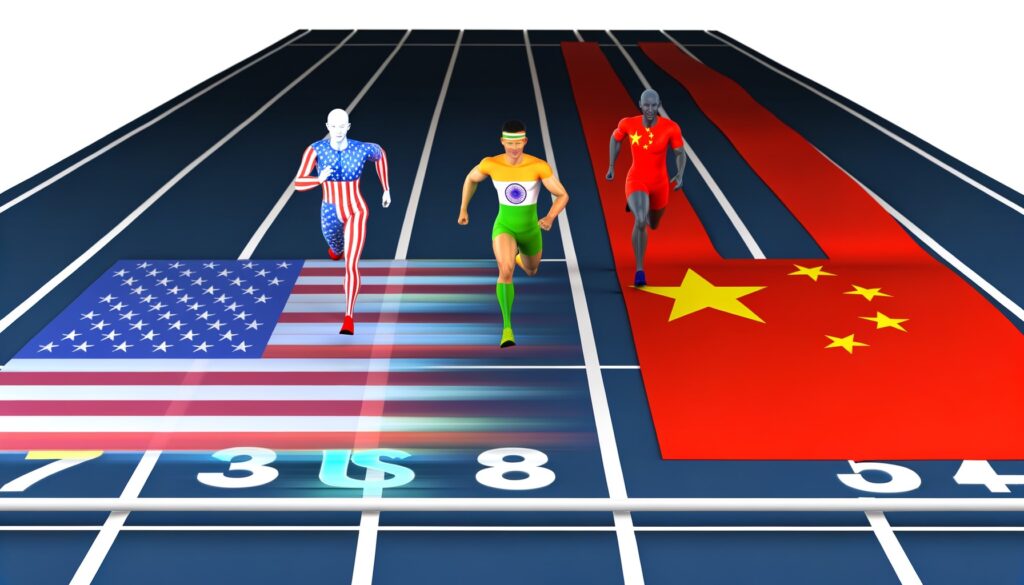
An essay on energy, order, and the physics beneath the competition
The dominant metaphor for artificial intelligence is the race: lanes, leaders, laggards, a finish line called AGI (artificial general intelligence) or “dominance.” The metaphor flatters our habit of reading history as a contest between agents. It also hides what is physically happening. A race presumes a fixed track and runners who can in principle stop and be counted. What we are actually watching is closer to a boiling pot: a rapidly growing flow of energy, capital, silicon, and data, passing through a set of institutions that are reorganising themselves around that flow.
Ilya Prigogine gave a name to this kind of object. In his work on non-equilibrium thermodynamics, for which he received the 1977 Nobel Prize in Chemistry, a dissipative structure is an ordered pattern that exists only because a system is open, held far from equilibrium, and continuously exporting entropy to its surroundings. The standard examples are Bénard convection cells, oscillating chemical reactions, and living organisms. Stop the flux and the structure vanishes. The order is not a possession; it is a rate.
This essay takes that idea seriously as the organising lens for the AI buildout. The claim is not that AI companies are literally Bénard cells. It is that the formal features of dissipative structures give a sharper account of what is driving, constraining, and likely to break this system than the vocabulary of competition does.
The four signatures
Four features define a dissipative structure. Each has an AI analogue.
An open system with a gradient. Bénard cells need a temperature difference between a heated floor and a cool ceiling. The AI system needs a gradient of usable energy and cheap capital. Without a continuous supply of both, nothing on the stack runs.
Throughput that sustains order. The structure is maintained by the flow, not by stored capital. In AI, a model is not an asset in the way a bridge is. It is a standing pattern in a river of electricity, GPU-hours, and fresh data, and it decays in relevance as the river moves on.
Nonlinear feedback. Self-organisation arises when fluctuations are amplified rather than damped. In AI, better models attract users, users attract revenue and capital, capital buys compute, compute yields better models. This is autocatalysis in the chemical sense.
Entropy export. Every ordered structure must dump disorder somewhere. For AI that means heat, carbon, grid instability, and water. The sink, not only the source, bounds how large the structure can become.
The empirical signature of a far-from-equilibrium system
The data now being published look less like an industry’s growth curve and more like the measurements of a system pushed ever further from equilibrium.
The gradient is steepening. Epoch AI estimates that training compute for frontier language models has grown roughly five-fold per year since 2020, with the power draw of frontier training runs growing around two-fold (2.2x) per year and the largest runs now exceeding 100 MW. The same body of work projects that continuing this trajectory to 2030 would require clusters drawing anywhere between 4 to 16 gigawatts (GW). Capital is following: the four largest US hyperscalers spent a record of roughly $410 billion on capital expenditure in 2025, and guidance as of mid-2026 points to about $725 billion this year, with banks such as Bank of America and Evercore projecting more than $1 trillion in 2027. Hyperscaler capex projections have surged to $5.3 trillion through 2030 (Goldman Sachs), against a broader $7.6 trillion AI infrastructure investment baseline for 2026-2031.
The flux is visible in the grid. The International Energy Agency reported in April 2026 that data-centre electricity demand grew 17% in 2025, against 3% growth in global electricity demand overall, and that demand from AI-focused facilities grew considerably faster, at about 50%. Its central projection is that data-centre consumption roughly doubles to around 945 terawatt-hours (TWh) by 2030.
The feedback is explicit. Microsoft reported its AI business at an annual revenue run rate above $37 billion, up 123% year on year, and told investors it would remain capacity constrained through 2026 even at that level of spending. Mark Zuckerberg’s stated preference to build ahead of demand rather than constrain research is, in thermodynamic language, a decision to hold the system far from equilibrium on purpose.
These are not the numbers of a market clearing at an equilibrium price. They are the numbers of a structure still being fed by a steepening gradient.
Why efficiency does not relax the system
A naive reading says efficiency gains should ease the energy problem. Epoch’s data show hardware efficiency, lower-precision arithmetic, and longer training runs together cutting power requirements per unit of compute by roughly a factor of two each year, and pre-training compute efficiency itself improving about three-fold annually. Yet total power still doubles.
Dissipative systems behave this way. Efficiency lowers the cost of maintaining a given level of organisation, and the saving is reinvested into more throughput. This is Jevons’s old observation about coal, rediscovered in thermodynamic dress. The IEA states the pattern plainly: energy per AI task is falling, and total consumption is still rising. In a system driven by positive feedback, efficiency is a fuel, not a brake.
The lens, therefore, predicts something specific: algorithmic breakthroughs that make intelligence cheaper, of the sort associated with DeepSeek in early 2025, will not reduce the buildout. They will widen the set of tasks for which it pays to run the structure, and push the system further from equilibrium.
The sink is the binding constraint
In the physics, the decisive limit on a convection cell is often not the heat source but the rate at which heat can be carried away. The AI system is now meeting its sink limits.
The IEA identifies shortages of gas turbines, transformers, and advanced chips, together with grid connection delays and permitting, as what is slowing data-centre development. Reporting from the US mid-Atlantic describes waits of up to seven years for grid connections in parts of Virginia, and an emergency order this summer allowing the grid operator PJM to push large data centres onto their own backup generators on short notice during a heat wave. PJM’s capacity auction prices rose from about $28.92 to about $329 per megawatt-day across three consecutive auctions, according to analysis relayed by industry commentators. These are what a system looks like when it has outrun the capacity of its environment to absorb its output.
The IEA’s own phrasing is instructive. AI, it says, is still an energy taker but is becoming an energy maker, pulling forward next-generation nuclear, flexible data-centre loads, and long-duration storage. That is the other thing dissipative structures do: they reshape their environment to sustain the flux. Convection cells organise the fluid. AI is reorganising the grid.
Geopolitics as gradient access
Seen this way, the US-China contest changes character. The scarce resource is not only the best chip or the best model; it is the capacity to sustain the largest, steadiest flux of electricity through computation without destabilising the host system.
On that axis the figures are stark, though sources vary in their exact numbers. Estimates for China’s 2025 additions range from roughly 430 GW of wind and solar alone to about 570 GW of total capacity, against something like 40 to 63 GW for the United States. BloombergNEF projects that China will add more than six times as much generation capacity as the US over the next five years. The US, for its part, retains the larger installed base of data centres (Stanford’s AI Index counts about 5,427 versus about 450 in China) and leading positions in advanced chips and frontier models.
The dissipative lens cuts both ways here, and it is worth being disciplined about it. A larger gradient does not guarantee a better structure. Structure depends on how flux is channelled: chips, talent, software ecosystems, and institutions that can convert power into capability. Chinese grids are also fragmented regionally, and commentators note that a planning system able to approve a national project cannot easily stop a useless one, so some capacity may be stranded. What the lens predicts is not that China wins, but that the contest shifts from who has the best design to who can best couple a design to a sustained energy flow.
The fragility of order held by flux
The most important implication of dissipative structure theory is also the least comfortable: these structures are robust to small perturbations and brittle to loss of throughput. They do not decline gracefully. Past a critical threshold they reorganise or collapse.
Several indicators suggest the financial form of the AI structure is already sensitive to its flux. Analysis of Microsoft’s filings notes that roughly two thirds of one quarter’s capital spending went to short-lived assets, mainly GPUs and CPUs, which means the structure must be refed continuously just to stay in place. One widely read analysis points out that Meta had around $12 billion of quarterly free cash flow against $145 billion of planned annual capex, and that the other three hyperscalers’ free cash flow fell sharply in the same period. Meta’s shares dropped about 9% on raising guidance, which could be read as the first fluctuation the system has had trouble absorbing. A June 2026 market note observed that data-centre lenders were treating hyperscaler commitments as nearly sovereign-grade (“in ways that were largely absent before 2024”), and warned that a pause by even one major player could reprice credit abruptly.
None of this proves a crash. It does identify where a crash would propagate: through the dependence of every layer, from lenders to turbine makers to chip fabs, on the continuity of one flux. Bénard cells do not wobble at the margin; they flip from one pattern to another at a bifurcation point. The right question is not whether growth continues, but which regime the system moves to when the gradient stops steepening.
Where the analogy breaks
Intellectual honesty requires marking the limits. Prigogine’s formalism applies rigorously to physical and chemical systems, and transplanting it to firms and states is analogy, not derivation. Firms make choices; convection cells do not. Capital can be created by policy in ways that heat cannot. Jeremy England’s “dissipative adaptation” thesis, which suggests matter tends to organise toward structures that absorb and dissipate energy efficiently, remains contested and should not be invoked as destiny. And the lens says little about what the structure is for. A system can be perfectly dissipative and still serve no one’s purposes.
The analogy earns its keep only where it generates testable predictions: that efficiency gains raise rather than lower total throughput, that binding constraints migrate from sources to sinks, that fragility concentrates at points of flux dependence, and that competition increasingly takes the form of competition for gradient access. So far, each has some empirical support.
What follows
If the AI system is a dissipative structure, several strategic conclusions change.
First, policy should target flux management rather than leader selection. Export controls on chips matter, but they act on one channel of a system whose binding limits are increasingly electrical.
Second, the highest-leverage investments may be in sinks and couplings: transmission, interconnection reform, storage, and flexible loads that let data centres yield to the grid at peak times. The IEA’s call for cooperation between governments, grid operators, and technology firms to make demand flexible is, in this reading, the policy equivalent of improving heat removal.
Third, resilience should be defined as the ability to remain organised under a reduced gradient. Systems with modest throughput requirements per unit of capability, such as efficient open-weight models run on cheap local power, may prove more robust than those that depend on ever-steeper flux.
Finally, the lens recommends humility about the word race. A race ends. A dissipative structure persists only while fed, reorganises when conditions change, and exports its disorder to whoever lives downstream. The more useful question for the coming decade is not who is winning, but what kind of order we are asking the world’s energy systems to sustain, at what rate, and with what cost to everyone outside the cell.