 Dr. Yashwant Singh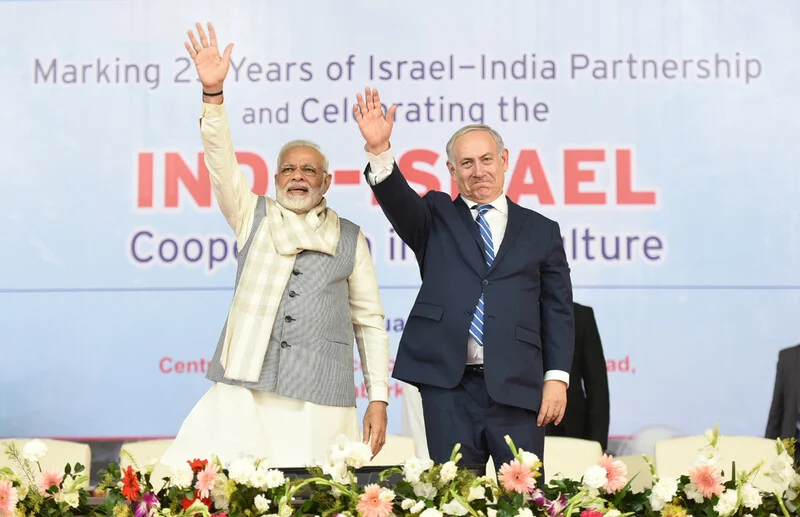
In December 2025, Narendra Modi flew to Addis Ababa. Ten days later, Israel did something no country had ever done: it formally recognized Somaliland, the breakaway northern region of Somalia, as an independent state, and opened full diplomatic relations with it. Two months after that, Modi flew to Israel itself, and the two countries upgraded their relationship to what they now call a “Special Strategic Partnership.” Around the same time, Benjamin Netanyahu floated the idea of a new grouping he called a “hexagon of alliances,” comprising India, Greece, Cyprus, and a handful of Arab, African and Asian partners, built to counter what he described as radical blocs in the region.
Put those events side by side and a tempting story writes itself: India and Israel, the thinking goes, are teaming up to redraw the map of influence in the Horn of Africa: India bringing legitimacy and development money, Israel bringing technology and hard security, together forming something like a new regional order.
The story sounds neat, but it misses some important nuance. A more accurate way to think about it is this: Israel doesn’t give India a completely new strategy in Africa. Instead, it sometimes strengthens parts of the approach India already follows, and at other times, it has little effect or even limits India’s room to manoeuvre.
India Was Already Playing This Game
Long before Modi shook hands in Jerusalem, India had its own reasons for wanting a bigger footprint in Africa, reasons that have nothing to do with Israel at all. India needs African minerals and energy. It wants African votes at the United Nations, especially for its long campaign to win a permanent Security Council seat. It has a large diaspora across East and Southern Africa. It sells weapons, trains foreign militaries, and wants a bigger say in Indian Ocean and Red Sea shipping lanes. All of that was true in 2015, when India held its first Africa summit in a decade, and it remains true today, as India and the African Union prepare to convene the fourth India-Africa Forum Summit at the earliest mutually convenient opportunity after its postponement in May 2026 because of the evolving public health situation linked to the Ebola outbreak in parts of Africa.
The point is: India’s African strategy is the main event. It existed before Israel showed up as a partner, and it will exist after. Israel is a supporting actor, sometimes a very effective one, sometimes a liability, but it isn’t co-writing the script.
Africa Isn’t One Country
The second thing the “India + Israel reshape Africa” story gets wrong is treating Africa as a single chessboard. It isn’t. The Horn of Africa – Somalia, Somaliland, Ethiopia, Djibouti, Eritrea, all clustered around the Red Sea and the Bab-el-Mandeb strait – runs on a completely different logic than West Africa, or Southern Africa, or North Africa. What works in Hargeisa tells you almost nothing about what will work in Lagos or Pretoria.
That’s why the Somaliland story is instructive but also easy to over-read. Israel’s recognition of Somaliland was met with immediate, near-universal condemnation, from Somalia itself, from Egypt, Turkey, Djibouti and Eritrea, and from the African Union, the East African regional bloc, the Arab League, and the European Union. That’s not the reaction of a continent quietly welcoming a new order. It’s the reaction of a very specific, fragile, contested corner of Africa reacting to a move that many of its neighbours saw as reckless. Whatever this episode tells us, it’s a story about the Horn, not about Africa as a whole.
Think of Israel as an Amplifier, Not a Co-Pilot
Here’s a simpler way to picture the relationship. Imagine India’s African strategy as a song it’s already writing and performing. Israel isn’t in the band. It’s more like an amplifier India can plug in when it wants a particular part of the performance, usually something technical, like drone surveillance, water technology, precision agriculture, or cyber defense, to come through louder and clearer.
That’s the real dynamic. In places like Kenya, Rwanda, or the small Indian Ocean island states, where governments mostly want practical help, in domains like maritime security, water systems or agricultural technology, plugging in Israeli technology alongside Indian financing and training tends to work well. Nobody in Nairobi is losing sleep over India’s association with Israel. The amplifier helps.
But in places where governments are more exposed, where Palestinian solidarity is a live domestic political issue, or where a country is carefully balancing relationships with Turkey, Iran, or Gulf states, the same amplifier can hurt. Algeria and South Africa are the clearest examples: both have long-standing, publicly popular positions on Palestine, and both would see close Indian-Israeli cooperation as a cost, not a benefit, to any relationship with New Delhi. India’s biggest asset in Africa has always been its image as a non-aligned, anti-colonial, Global South partner, not a great power looking to impose its friendships on others. Whenever Israel’s presence threatens that image, it isn’t multiplying India’s influence. It’s taxing it.
Why This Matters Right Now
This isn’t an abstract academic point. It’s playing out in real time. The current moment makes the “conditional amplifier” framing more urgent, not less, for a few reasons:
First, the region is more polarized than it’s been in years. The 2025-2026 period saw not just the Gaza war but a wider conflict involving the United States, Israel, Iran, and Gulf states. That kind of regional conflagration raises the political temperature everywhere, making African governments more attentive, not less, to who they’re seen standing next to.
Second, Israel is explicitly trying to build a bloc, not just sign bilateral deals. Netanyahu’s “hexagon of alliances” idea, a grouping India with Greece, Cyprus, and unnamed Arab, African, and Asian states, is a different animal from quiet technology transfers. A formal bloc is visible, and visibility is exactly what raises the political cost for African governments that would rather not pick sides. India joining such a structure changes the calculation: cooperation that once looked like discreet, deniable technical assistance starts looking like alignment.
Third, India has genuine reasons to keep its options open. Turkey and China both compete for the same market, specifically surveillance drones, port infrastructure and security training, often without the political baggage Israel carries in parts of the continent. If India’s goal is maximum African influence, not loyalty to any single partner, it has every incentive to treat Israel as one tool among several, not as a fixed alliance.
Fourth, African governments themselves are pursuing more diversified foreign policies. Many states are deliberately avoiding exclusive alignments with any single external power, preferring to balance relationships with multiple partners, including China, Turkey, the Gulf states, India, the European Union, and the United States. In that environment, an overt India-Israel strategic bloc could make cooperation with India politically more complicated for governments that want to preserve diplomatic flexibility or avoid domestic and regional criticism. By contrast, if India maintains a broader, less exclusive network of partnerships, it is often easier for African states to engage with New Delhi without appearing to join a particular geopolitical camp.
Together, the four arguments reinforce the central claim that Israel functions as a conditional amplifier: it can enhance India’s influence under some circumstances, but the value of that partnership depends on the broader regional and political context rather than automatically increasing India’s leverage everywhere.
A Better Question Than “Can They Do It Together?”
The right question isn’t whether India and Israel can cooperate in Africa. Obviously, they can, and in some places they already do, productively. The right question is: where does that cooperation actually help India, where does it quietly cost India something, and what determines the difference?
The honest answer, based on what’s unfolded over the past year, is that it depends on two things: how much a given African government actually needs what Israel specifically offers, and how politically exposed that government is if the association becomes public and permanent. Get both right (a technical need, a government with room to manoeuvre), and the partnership is a genuine asset. Get either wrong (an unnecessary capability, or a government under domestic pressure over Palestine), and the same partnership becomes a liability that undercuts the very thing that made India valuable to Africa in the first place: the sense that it was never anyone’s proxy.
The Bottom Line
India’s Africa strategy is better understood as India’s own long-running project, anchored in trade, diaspora ties, UN diplomacy, and maritime interests, that occasionally gets a technological boost from Israel, and occasionally pays a political price for it, depending entirely on where in Africa, and with whom, the partnership shows up. The Horn of Africa in 2025-2026 has been a live demonstration of both sides of that coin: real strategic upside in some corners, real reputational risk in others. Anyone trying to understand where this goes next should stop asking whether the India-Israel relationship is good for Africa policy, and start asking, case by case, whether it’s good here.
Dr. Yashwant Singh is a sociologist, recently served as an Assistant Professor in the Department of Sociology at GITAM (Deemed to be) University, Bengaluru, India. He holds an M.Phil. in Sociology from the University of Delhi and a Ph.D. in Sociology from the University of Hyderabad, India. His research interests include urban sociology, the sociology of development and geopolitics. His writings have appeared on several digital platforms, including Across Voices, Modern Diplomacy, Geostrategic Media, South Asia Journal, World Geostrategic Insights and IA-Forum.