 Dr. Angana Guha Roy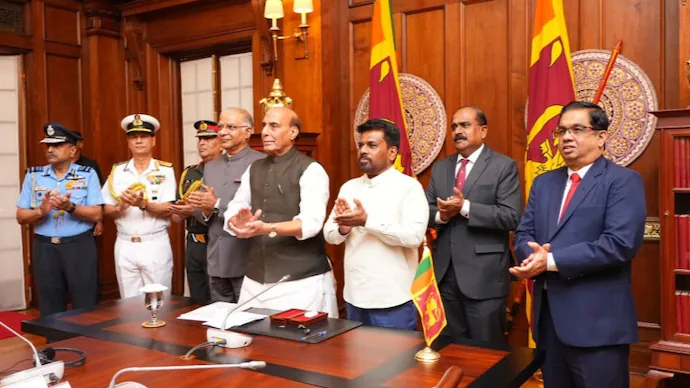
Defence Minister Rajnath Singh’s recent visit to Sri Lanka was highly significant. It led to the signing of three Memorandum of Understandings (MOUs) followed by formal dialogue between the top leadership of the two countries fundamental to security and defence verticals of India- Sri Lanka bilateral relationship. The engagement was a step ahead from India’s longstanding nature of post crisis economic engagement towards a more concrete hard security alignment under India’s MAHASAGAR and Neighborhood First policies.
The visit has been deemed significant for breaking a four decade pause in defense ministerial visits between the two countries following sensitivities and fallout from IPKF deployment during civil war in Sri Lanka. Defence Minister Rajnath Singh’s visit to IPKF memorial in Colombo honouring the death of Indian soldiers is evident of the fact that India is willing to consolidate its defence cooperation with Sri Lanka taking into account the past sensitivities and mutual recognition of shared challenges and concerns in the relationship.
Indian Defence Minister’s recent visit preceded by PM Modi’s April 2025 visit that culminated into a 5-year landmark defence umbrella agreement, after 1987, aimed at laying the foundation for implementing practical integrated hard security pacts in the coming years. The defence pact focused on core areas like maritime surveillance and security, defence exchanges, joint training and capabilities, and exploring opportunities in defence procurement.
The timely visit touched upon each segment of the formalized cooperation agreement through MOUs (at equipment and institutional level) and layered dialogue with Sri Lanka’s top leadership reviewing the ambit of the formal cooperation agreement’s functional capabilities moving towards a more structured partnership.
While India is translating MOUs to immediate field deployment, Defence Minister Singh made formal announcement of funding the overhauling of remaining six L 70 anti-aircraft guns. The move has attracted conflicting views as some experts believe that L70, cold war era ‘vintage’ equipment, is more a token gesture and should not be amplified as a major highlight of defence cooperation talks during Rajnath Singh’s visit. Counter arguments state that L 70 upgradation adds value to Sri Lanka’s air defence architecture given its successful operation in Operation Sindoor last year.
The NDC( National Defence Colleges) and NCC ( National Cadet Corps) MOU formalization for academic, cooperation, knowledge sharing, and youth exchange respectively will facilitate professional military engagement at multiple level( senior officer, academic and youth) helping to establish structured dialogue channels.
In November 2025 Cyclone Ditwah caused widespread infrastructure damage in the wake of floods and landslides across Sri Lanka. This was followed by the announcement of a comprehensive USD 450 million reconstruction and rehabilitation package by India, a portion of which was specifically earmarked for Bailey bridge projects to restore critical road links. Indian Army Engineer Task Force teams have been working on various Bailey bridge projects since early 2026. The three inaugurated during Rajnath Singh’s visit are part of this ongoing effort. Prevailing opinion suggest that such efforts are good for India’s wider infrastructure outreach to balance China’s heavy infrastructure led footprints in Sri Lanka.
Indian Defence Minister Rajnath Singh’s proposal (in alignment with MAHASAGAR) to collaborate as equal partners in building an integrated, real-time maritime surveillance grid requires direct interaction between the coast guards, navies, and relevant stakeholders. It is aimed at jointly addressing critical security issues like illegal fishing, suspicious vessel docking, narcotics trafficking, and prevent maritime terrorism.
Meanwhile, President Anura Kumara Dissanayake’s consistent strategic commitment of not allowing Sri Lanka territory to be used against Indian interests is cornerstone of his administration’s foreign policy. President Dissanayake reiterated this commitment during Defence Minister Rajnath Singh’s visit explicitly. Sri Lanka’s official position, important for maritime security dynamics in the Indian Ocean Region, is much appreciated, trusted and acknowledged among the strategic community in India. President Dissanayake’s repetitive assurance to PM Modi and now Defence Minister Rajnath Singh is supported by Sri Lanka’s recently adopted uniform port entry guidelines under which foreign vessels need to submit clear scientific objectives, lists of onboard equipment and operational schedules. Experts believe, Sri Lanka’s moratorium on the entry of foreign research vessels stems from its strategic choice of not being identified as a threat inducer in the Indian Ocean Region as it has to tactically balance its trading and working equation with India, US, and China.
India’s broader framing of MAHASAGAR and Neighborhood First policy is not directed against China. At the same time the multi layered dialogue that point towards capacity enhancement, strengthening multidomain awareness and commitment of protecting mutual security interests stem from the possible challenges emanating from China’s strategic presence in Sri Lanka and the Indian Ocean Region.
A lot of emphasis has been put on multi decadal pause of defence ministerial level exchanges between the countries. Fact remains, despite New Delhi’s deliberate attempt to avoid structured defence level dialogues or concretising defence cooperation agreements, lower-level military engagement continued between India and Sri Lanka in the past. So was the continuation of consistent exchanges between top political leadership in the wider gamut of South Asian regional diplomacy.
Sri Lanka has always maintained its position of non-alignment, avoiding alliances amid major power rivalry in the Indian Ocean Region. Even with its largest trading partner India, its policy of defence procurement prefers grant funded capacity building initiatives instead of large-scale arms purchases.
While Defence Minister Rajnath Singh’s visit has been strategically viewed as a success, India’s continuity in holding the momentum can guarantee greater synergy in near future.
Dr. Angana Guha Roy is an independent Research Analyst based in New Delhi. She writes on Foreign Policy, Geopolitics, Defence and National Security, and other prominent issues in International Relations.


 A.Jathindra