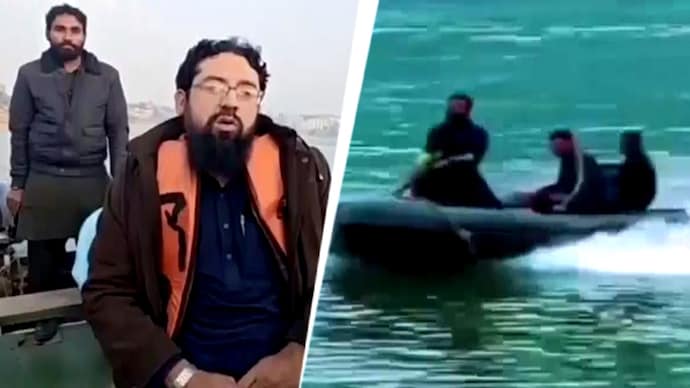
“In 2026, something will happen related to water” exhorted Muhammad Haris Dar in a video released in July 2026. Dar is the finance secretary and the President of its Central Punjab unit of Pakistani Markazi Muslim League (PMML) which is the political front of proscribed Lashkar E Toiba (LeT). Dar himself has been designated by the United States Government as a Specially Designated Global Terrorist (SDGT). Dar who appeared to be addressing a group of marine trainees, goes on to motivate them, urging them to be “prepared and work with the Jamaat” ostensibly referring to LeT. This brazen threat comes at a time when India has abrogated the Indus Water Treaty, after the Pahalgam attacks last year.
Lashkar’s Maritime Terrorism Initiative
It is believed that LeT is using political, student, humanitarian and religious charity fronts such as PMML, Muslim Youth League (MYL), Muslim Students League (MSL), Muslim Rescue Mission (MRM) and Khidmat E Khalq, to train hundreds of youngsters at various locations on swimming, high speed boat handling, scuba diving, frogman operations and amphibious activities since last year. LeT is believed to be training cadres at multiple indoor and outdoor locations at Lahore, Faisalabad, Rahim Yar Khan, under “Hazir Jawan” program disguising these trainings as disaster and emergency response training. Atleast 135 cadres were believed to have undergone this training program successfully as of beginning of this year, indicating that these numbers may have gone up by now.
The training itself is believed to be divided into two levels, first is the basic level which is confined to indoor pools and the next level is conducted in bigger rivers and dams. Training facilities are based at multiple sites located inside Pakistan such as Islamabad, Muridke, Lahore, Bahawalpur, Karachi, Kasur, Alipur and in Pakistan-administered Kashmir (POK) sites such as Suran River (Poonch), Mangla Dam (Mirpur), and Muzaffarabad are being used. It is believed that some members of Pakistan army’s special force unit, Special Security Group (SSG) are involved in imparting both basic and advanced training for these young recruits. In July 2026, a retired SSG instructor is believed to have trained recruits in Chakwal located in Punjab last year which was confined to swimming pools. However, later inputs emerged that some LeT recruits were being trained in frogman operations and underwater missions especially in Mangla Dam area by SSG instructors. In July 2026, a video of LeT cadres emerged who were training in Mangla dam in Pakistan-occupied Jammu and Kashmir.
The fact that LeT recruits are being trained in advanced scuba diving and underwater operations in a facility such as Mangla dam, are clear signs of possible sea borne or water front terror attacks on coastal facilities and infrastructure such as dams. And these, from India’s point of view, are a cause of concern as history is replete with precedents that showcase anti-India terror groups such as LeT’s and Al Qaeda’s intent in the past, to use maritime routes to plan and orchestrate terror attacks in India’s Western and Southern coasts.
Multiple Terror Plots – From West Coast to South of India
To begin with, the biggest and the most feared attack conducted by LeT was the Mumbai attack where the initial ingress was through the sea route. The terrorists who were sea borne for a few days travelling in larger ships, before hijacking a shipping trawler to enter the Indian coast, gained access to the Mumbai’s shores using a heavy-duty inflatable boat. According to David Coleman Headley, who conducted reconnaissance for this plot, the terrorists were trained in marine operations and navigation sea borne maneuvers at the SSG facility located at Mangla dam. Mangla dam is a known training facility of SSG Navy commandoes and was identified as a key training site for LeT recruits in marine commando techniques as early as 2002. Against this backdrop, the latest revelation that LeT cadres are being trained in the same facility, should be a red flag for the Indian security agencies.
Furthermore, a plot in 2014, by the Al Qaeda in the Indian Subcontinent (AQIS) to hijack a Pakistani naval ship PNS Aslat from a Pakistani Naval Dockyard near Karachi and to attack Indian naval ships using anti-ship missile off Gujarat coast stands testimony to the fact that not only LeT but other groups such as Al Qaeda affiliates also have planned such sea borne attacks. In 2019, Gujarat on the Western coast, near Pakistan was put on high alert, fearing infiltration and attack by sea borne terrorists on Mundra and Kandla ports. This alert was issued at a time when India had abrogated special status vested under Article 370 to Jammu & Kashmir.
In addition, to the South of India, and in an equally important plot, elements linked to Pakistan’s Inter-Services Intelligence (ISI) were believed to be planning a terrorist attack in Tamilnadu using the sea route. The original objective of this plot, was espionage activity targeting port facilities including naval base INS Varsha located in coastal Andhra Pradesh. This network was run by ISI station head Amir Inayat @ Boss and Amir Zuabir Siddqui, both based at Pakistan High Commission, Colombo. Amir Zuabir Siddqui is believed to a captain rank officer who had previously served in Pakistan naval airbase PNS Mehran. Two Sri Lankans and one Indian were arrested in this regard by the National Investigation Agency (NIA) in Tamilnadu. One of the arrested Sri Lankan national Zakir Hussein later confessed to the existence of a subplot to the main espionage plot. According to him, his associate Mohammed Hussain Mohammed Sulaiman, a Sri Lankan based in Malaysia tasked him to conduct reconnaissance of the US Consulate in Chennai and Israeli Consulate in Bangalore. It was later revealed that Sulaiman wanted to attack the US and Israeli Consulates using suicide bombers. As a part of this plot, Suleiman was planning to use the sea route to smuggle two suicide bombers into Tamilnadu from Maldives. Sulaiman was eventually arrested and deported to Sri Lanka by the Malaysian authorities, despite India seeking his extradition.
In light of the above, terrorist attacks in India, using sea route appear to be looming large at this moment. Not only coastal infrastructure such as ports and cities in the Western and Southern coast could be targeted, terrorist groups such as the LeT could target infrastructure such as dams and hydel projects in Jammu & Kashmir region which they accuse as being used to stop water to Pakistan. Additionally, attempts to board Indian ships at high seas with an aim to hijack the ship or ram Indian ships using explosive laden vessels similar to USS Cole attack is also a possibility. On the other hand, a successful attack using the sea mode or against coastal assets such as nuclear plants located at Kalpakkam, Kudamkulam in Tamilnadu, will gain visibility and traction for LeT, resulting in increased recruitment and funding.
Past attempts by ISI supported terror groups such as LeT, have showcased its intent and ability to mount such attacks. Given the recent updates, LeT clearly appears to ramp up its ability and capability to mount sea borne assault which has increased the threat to Indian coastal assets manifold. This in turn, places an imperative on the Indian security agencies to pre-empt them. After all Mumbai attacks in 2008 would never have happened, if the Indian intelligence community had taken serious note of LeT undergoing marine training in Mangla dam in 2002 Likewise, Indian security planners remaining oblivious to the latest threat from LeT, will again be at India’s own peril.
Dr V. Balasubramaniyan holds a PhD in Terrorism Financing from the Research Centre of Defence and Strategic Studies at Gurunanak College, Velachery, Chennai, Tamil Nadu, India. His research focuses on terrorism financing in India and its implications for national security. His areas of interest include terrorism, terrorism financing, geopolitics, economics, extremism, and deradicalisation. He has published articles in the Journal of Money Laundering Control, Defence Watch, CLAWS, Agni, and Aakrosh, and is a regular contributor to Geopolitical Monitor, Canada. He is currently an independent counter-terrorism specialist working with a range of institutional partners. He has also advised several organisations, including the Government of India.

 A.Jathindra