 Dr. Yashwant Singh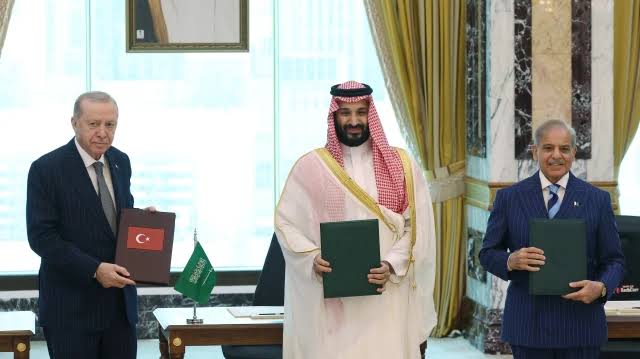
How New Delhi can raise the costs of cross-border terrorism without walking into an escalation trap, and why a geopolitically complete answer has to include the Eastern Mediterranean, not just West Asia.
In August 2026, Saudi Arabia, Pakistan and Turkey signed the Mecca Joint Defence Agreement, a trilateral collective-defense pact declaring that an armed attack on one signatory constitutes an attack on all three. The deal was struck against the backdrop of a live war: Iran and its allies had been striking Gulf targets since the United States and Israel attacked Tehran in February 2026, and Riyadh’s underlying motive was self-insurance against that threat, not the India-Pakistan dispute. Read in isolation, the pact says little about South Asia. Read alongside events fifteen months earlier, the April 2025 terrorist massacre of 26 civilians at Pahalgam in Kashmir, and India’s subsequent Operation Sindoor strikes into Pakistani territory, it sits inside a larger and more urgent question that New Delhi’s strategic community has been debating with unusual candour: how does a democratic, nuclear-armed rising power respond to a neighbour that has used sub-conventional militancy as an instrument of state policy for four decades, when that neighbour’s most consequential defense partner is not a distant patron but a NATO member with its own long-running maritime and territorial disputes just across the Mediterranean?
This is not a question with a clean answer. It is a question of trade-offs: between deterrence and escalation, between punishment and proof, between alliance-seeking and strategic autonomy. What follows tries to lay those trade-offs out plainly, including the ones that require looking well outside South Asia.
The Logic of Proxy War, and Why It Has Persisted
Pakistan’s use of militant proxies against India traces to the insurgency in Punjab in the 1980s, intensified after the Kashmir insurgency began in 1989, and has produced a recognizable sequence of mass-casualty attacks: the 2001 Parliament attack, the 2008 Mumbai siege, Uri in 2016, Pulwama in 2019, and Pahalgam in 2025. Groups such as Lashkar-e-Taiba, Jaish-e-Mohammed, and newer fronts like The Resistance Front have been repeatedly linked by Indian investigators, and at times by U.S. and United Nations designations, to Pakistan-based infrastructure. Pakistan disputes state culpability and has itself suffered heavily from terrorism, including attacks by the Pakistani Taliban on its own security forces, a reminder that the region’s militant ecosystem is sprawling and not entirely controllable even by its sponsors.
The strategic logic, as scholars of proxy warfare have long noted, is straightforward: Pakistan cannot match India conventionally or economically, so it uses deniable non-state violence to impose costs while sheltering under the assumption that its nuclear arsenal forecloses large retaliation, that non-state actors preserve deniability, and that external patrons will cushion the diplomatic fallout. What the 2025 crisis exposed, and what a properly geopolitical analysis has to reckon with, is that one of those patrons is no longer just supplying rhetoric, it is supplying hardware in real time.
Operation Sindoor: The Turkish Dimension
After the Pahalgam attack, India launched Operation Sindoor on May 7, 2025, striking nine sites inside Pakistan and Pakistan-administered Kashmir, including facilities associated with Lashkar-e-Taiba and Jaish-e-Mohammed. Pakistan’s retaliation over the following days involved waves of 300 to 400 drones (India neutralized over 600 drones during the four days’ conflict, as per a ToI report), as Indian officials identified wreckage from Turkish-made Asisguard Songar systems, and Pakistan separately deployed Turkish Bayraktar TB2 and YIHA platforms, targeting Indian military infrastructure from Jammu to Rajasthan. Indian intelligence assessed that Turkish advisors were directly involved in planning and coordinating these drone operations, and two Turkish contractors reportedly assisting Pakistan’s drone effort were killed in an Indian strike. A ceasefire was reached after roughly four days of exchanges, brokered through direct military-to-military contact. India separately placed the 1960 Indus Waters Treaty in abeyance, treating a previously untouchable instrument as a lever of policy for the first time in six decades.
The significance of Sindoor is less the tactical outcome than the doctrinal claim embedded in it: that any attack traceable to Pakistani soil will draw a calibrated but unambiguous conventional military response, deliberately testing the assumption that nuclear overhang forecloses such options. Whether this constitutes durable deterrence or merely resets the threshold at which the next crisis begins is contested even within India’s own strategic community. Assessments from institutions such as the Carnegie Endowment have noted real vulnerabilities exposed during the exchange, particularly in sustaining air-defense saturation against a determined drone-and-missile barrage, that would need to be resolved before “retaliation at the source” can be treated as a reliable long-term doctrine rather than a one-time demonstration.
Turkish President Recep Tayyip Erdoğan telephoned Prime Minister Shehbaz Sharif during the crisis to convey solidarity. Earlier in August 2023, Pakistan’s National Aerospace Science and Technology Park had signed a research agreement with the Turkish drone manufacturer Baykar. All of this predates the “Mecca Pact” by over a year; the August 2026 agreement formalizes a defense-industrial relationship that had already been operationally tested, against India, in combat.
This matters because it changes the analytical question. Turkey is not a passive signatory lending its name to a Gulf-brokered communiqué. It is Pakistan’s most consequential wartime supplier after China, it has consistently backed Islamabad’s position on Kashmir at the UN and in the Organisation of Islamic Cooperation, and its president has used Kashmir rhetorically to build standing across the Muslim world in a manner India’s foreign ministry has repeatedly and publicly protested. A geopolitically complete essay cannot treat Ankara as a secondary character in a Gulf story; it has to treat Turkey as an independent actor with its own grievances against the West, its own expeditionary ambitions in the Eastern Mediterranean, Libya, the Caucasus and Central Asia, and its own reasons, dating to well before the “Mecca Pact”, for finding value in Pakistan’s rivalry with India.
The Eastern Mediterranean as a Second Front: Greece, Cyprus, Armenia
This is where India’s response has, in fact, already extended geography that most South Asia-focused commentary ignores. Turkey has unresolved maritime and airspace disputes with Greece dating back decades, and an unresolved partition of Cyprus since 1974, with Ankara’s “Blue Homeland” (Mavi Vatan) doctrine asserting expansive claims over Eastern Mediterranean waters that Athens and Nicosia both reject. Since 2025, Indian and regional defense reporting has documented a rapid deepening of India’s ties with exactly these two Turkish rivals, plus Armenia, which has its own adversarial history with Turkey and Turkish-backed Azerbaijan.
The specifics, as reported: the Indian Navy’s frigate INS Trikand conducted the first-ever bilateral maritime exercise with the Hellenic Navy at Salamis Bay in September 2025; India and Greece have discussed sharing Rafale operational data, and reports have suggested Indian interest in supplying Greece with long-range land-attack cruise missiles in the 1,000-1,500 km class, read in Ankara as a direct response to Turkish drone support for Pakistan. Cyprus and India upgraded their relationship to a full Strategic Partnership during President Nikos Christodoulides’s May 2026 state visit to New Delhi, anchored by a five-year Roadmap for Bilateral Defence Cooperation covering counterterrorism, cybersecurity, and maritime cooperation, with reports of Cypriot interest in acquiring Indian BrahMos cruise missiles and loitering munitions, platforms that would directly complicate Turkish naval planning in Cypriot waters. Armenia, meanwhile, has become one of India’s largest defense-export markets, with contracts reported in excess of $720 million covering Pinaka rocket systems, Akash air defense, and other platforms, a relationship that sits inside Yerevan’s broader confrontation with Turkish-backed Azerbaijan. Greek commentary condemning the Pahalgam attack in solidarity with India, and Turkish media describing India’s outreach as deliberate “encirclement,” both point to the same underlying pattern: a tit-for-tat logic in which Ankara’s support for Islamabad in South Asia has been met with Indian support for Ankara’s rivals in the Mediterranean and Caucasus.
Two caveats belong here, in the interest of rigor. First, much of this reporting comes from Indian strategic-affairs outlets and regional defense press rather than from Reuters-tier wire confirmation on every specific platform sale, and some of the more triumphalist framing (“encirclement,” “strategic nightmare for Turkey”) reflects commentary rather than confirmed doctrine; the underlying naval exercises, the Cyprus strategic partnership, and the Armenian export relationship are corroborated across multiple independent reports, but individual weapons-transfer claims should be read with appropriate caution pending fuller confirmation. Second, Turkish officials have reportedly signalled a wish to decouple their India relationship from their Pakistan relationship, aware that continued deterioration carries real economic costs, as the Turkish exports and construction contracts in India are not trivial, which suggests Ankara itself may not want this rivalry to harden indefinitely.
A Fourth Front: Instrumentalizing Turkey’s Own Vulnerabilities
The Greece-Cyprus-Armenia vector should be understood as India’s seventh policy instrument, additive to the six already available against Pakistan directly (kinetic retaliation, water leverage, diplomatic-legal isolation, intelligence disruption, economic denial, and internal resilience; as explicated in the later section): raising the diplomatic and strategic cost of Ankara’s Pakistan policy by strengthening the actors Turkey itself treats as primary threats. This is not symmetrical warfare, as India is not going to war with Turkey, but it mirrors exactly the logic Pakistan has used against India for decades: impose cost on an adversary by strengthening its regional rivals, at a level below direct confrontation. Applied to Turkey, it has three real functions. It signals to Ankara that support for anti-India militancy is not cost-free even outside South Asia. It builds India defense-export markets and diplomatic capital in a region, which is, the Eastern Mediterranean and South Caucasus, that also intersects with European energy routes and NATO’s southeastern flank, giving India relevance to European capitals beyond IMEC. And it gives India leverage that can be traded down, not just escalated, if Ankara does choose the decoupling path some Turkish officials have floated.
The Ceiling Deterrence Cannot Remove
None of this alters the underlying military calculus with Pakistan itself. Islamabad possesses a nuclear arsenal estimated at more than 170 warheads and a declared doctrine of “full-spectrum deterrence” designed to threaten escalation at low conventional thresholds, precisely to deter retaliation of the kind India carried out in 2025. Operation Sindoor tested that firebreak without dissolving it, and the effective decision-maker on proxy support remains Pakistan’s military-intelligence establishment rather than its elected civilian government, currently under Field Marshal Asim Munir, who has simultaneously deepened Pakistan’s Turkish defense-industrial relationship, brought the “Mecca Pact” to fruition, and cultivated an unusually warm personal rapport with the U.S. president, including an unprecedented White House lunch in June 2025. That last fact is a reminder that India’s diversification strategy has to be built on partners with a genuine track record under fire, chiefly Russia and Israel, whose S-400 and Barak-8 systems carried the actual air-defense burden during Operation Sindoor, with France a credible and rising third, rather than on the assumption that any single Western relationship will hold steady through a crisis.
A Menu Without a Silver Bullet
Against Pakistan directly, India’s toolkit runs across six familiar instruments, layered rather than singular: calibrated kinetic retaliation, now precedent but escalation-prone; water leverage through the Indus treaty’s abeyance, whose value lies in accelerating legal hydropower development rather than any real physical chokehold; diplomatic-legal isolation via FATF and UN designations, constrained by China’s Security Council position; quiet intelligence-led disruption of financial and militant networks; economic pressure exploiting Pakistan’s IMF dependence and Gulf remittance flows; and internal resilience in Jammu and Kashmir and along the coast, addressing vulnerability rather than the source and boosting layered security upgrades. To these must now be added the seventh, extraterritorial instrument described above: raising Ankara’s costs through Athens, Nicosia and Yerevan.
The Gulf states, the UAE, Saudi Arabia, Qatar, and Oman, matter for financial-intelligence cooperation and for the economic interdependence that constrains Riyadh’s ability to subordinate its India relationship to its Pakistan one, even as it deepens both. And a broader constituency across ASEAN, Africa, and the wider Global South provides cumulative diplomatic weight in the UN and FATF-adjacent forums that India has cultivated deliberately through vaccine diplomacy, development financing, and its own convening of Global South summits.
None of this is alliance-building in the traditional sense, and it should not be mistaken for it. It is instead a wager, consistent with India’s long-standing preference for strategic autonomy, that in a regional order increasingly organized around overlapping, threat-specific coalitions like the “Mecca Pact” rather than fixed Cold War-style blocs, the actor with the densest web of functional partnerships, not the actor with the largest single alliance, accrues the most durable leverage.
Beyond Retaliation: Diversification as Grand Strategy
A geopolitically sound account of India’s options in 2026 cannot stop at the Arabian Sea. Turkey’s role in the “Mecca Pact” is not incidental. It is the continuation of a defense-industrial and diplomatic relationship with Pakistan that was already firing drones at Indian forces in May 2025, and India’s response has already extended, in kind, into the Eastern Mediterranean and South Caucasus. The resulting picture is one of simultaneous, multi-theater layering: calibrated deterrence and internal resilience against Pakistan directly; diversified, crisis-tested technology partnerships anchored in Moscow and Jerusalem, also Paris, rather than an unreliable Washington; and a deliberate strengthening of Ankara’s own regional rivals to ensure that Turkey’s backing for Islamabad is not cost-free. None of these levers, alone, resolves the underlying problem of a nuclear-armed neighbor’s use of proxy violence. Together, they represent the only strategy consistent with what has actually held up under crisis conditions since 2025, and the only one broad enough to account for every variable actually in play.