
 Dr. Yashwant Singh
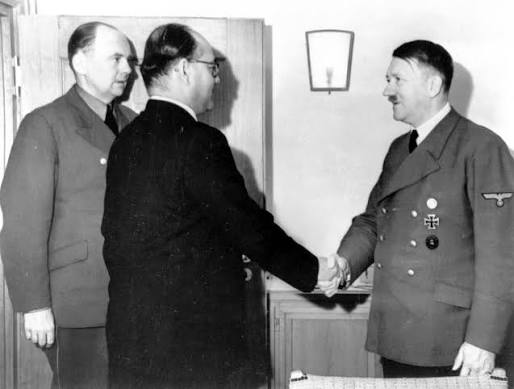
Subhas Bose and Risto Ryti: two men who turned to Hitler’s allies, yet inherited vastly different moral legacies. How power, circumstance and the politics of memory shaped the unequal judgment of their wartime choices.
On June 26, 1944, as Soviet forces ruptured the Finnish line on the Karelian Isthmus, President Risto Ryti signed a personal undertaking to Hitler that Finland would make no separate peace. Germany supplied the weapons that stabilised the front. The Panzerfists anti-tank weapons supplied by Germany played a crucial role on the Karelian Isthmus, contributing significantly to the destruction of numerous Soviet tanks. Fourteen months earlier, in the Indian Ocean southwest of Madagascar, Subhas Chandra Bose had been transferred by rubber dinghy from a German U-boat to a Japanese submarine, the only such transfer in the war. He was on his way to take command of an Indian army that had no state behind it.
One man kept a seat in the councils of the Western order. The other became its standing example of dubious loyalty. The disparity is not explained by the evidence, which is why it deserves to be examined as a question about the historian’s craft: when moral scrutiny falls this unevenly, what is doing the work?
The Ledger of a Sovereign
Ryti’s case is usually told as the Winter War and its sequel: a small democracy attacked on November 30, 1939, holding for 105 days, and losing a tenth of its territory in March 1940. That story is true, and it earns Finland real sympathy. But it ends in March 1940, and Ryti’s responsibility begins afterwards.
In 1940-41 Finland turned toward Germany, accepted German troops in Lapland, and joined the invasion of the Soviet Union in June 1941. “Co-belligerency” was a diplomatic label, not a description of the military reality. Finnish forces did not stop at the 1939 frontier. They advanced into Soviet Karelia and toward the Svir, in a campaign shaped by the dream of a “Greater Finland.” Ryti shared that ambition. In the occupied territory, Finnish authorities interned much of the Russian-speaking civilian population in camps, where thousands died of hunger and disease. Finland handed over to Germany several thousand Soviet prisoners of war, some of whom were certainly killed, and a small number of Jewish refugees. Finnish forces on the northern front helped keep Leningrad encircled, even if Mannerheim declined to storm it. Ryti, as head of state, signed the 1944 pledge that lashed Finland to Hitler’s fortunes at the moment of defeat.
None of this erases Finland’s real distinction. Its Jewish citizens were not deported, its parliament functioned, and it never became a satellite in the way Slovakia or Hungary did. The point is that Ryti governed a state with a functioning army, a foreign policy, and the power to refuse. Every one of these decisions was a sovereign’s choice, taken with options.
The Ledger of a Stateless Man
Bose had no such options. A twice-elected president of the Indian National Congress (1938 and 1939), he was driven out of the party’s leadership and then imprisoned by the Raj. He escaped house arrest in Calcutta in January 1941 and travelled through Afghanistan and Soviet territory to Berlin. He commanded no territory, collected no taxes and ruled no population. His assets were his prestige, his voice on the radio, and whatever he could obtain from patrons who despised him.
In Berlin the harvest was thin. He obtained a Free India Centre and a radio service, and the Indian Legion, recruited from prisoners of war captured in North Africa. Its soldiers swore an oath naming Hitler as their commander, and the unit was eventually absorbed into the Waffen-SS. What Bose did not get was what he came for. When he met Hitler on May 27, 1942, he found a man who regarded Indians with the contempt visible in Mein Kampf and who would offer no declaration of Indian independence. Romain Hayes, in his study of Bose in Nazi Germany, shows how modest and instrumental German interest in him remained. Berlin saw an asset for propaganda and subversion, not a future head of state.
Japan offered more because its position in Asia was stronger. After Singapore fell in February 1942, tens of thousands of Indian soldiers of the British army became prisoners. A first Indian National Army, under Mohan Singh, collapsed in December 1942 amid disputes with Japanese commanders over its autonomy. Bose arrived in Singapore in mid-1943 and rebuilt it. He declared a Provisional Government of Free India that October, recognized by Japan and its dependents, and the INA marched into Manipur in the Imphal-Kohima offensive of 1944. The principal fighting, however, was conducted by Japanese and Allied forces. The offensive ultimately ended in Japanese defeat and retreat. The INA’s soldiers, Hindu, Muslim and Sikh, served under a single command, in a single language, with a single salute: Jai Hind. It was destroyed by disease, hunger and British arms.
Set the two ledgers beside each other. Ryti’s carries camps, a territorial war of conquest, prisoner handovers, and a binding pledge to Hitler. Bose’s carries a flawed alliance with brutal patrons, a propaganda apparatus, and an army that fought the colonial power it was founded to fight. No comparable record of mass killing attaches to his forces. Bose was never a fascist in the sense of adopting its racial doctrine. His INA recruited across religion. Yet he was no liberal democrat either. He should not be exempted from criticism: his admiration for authoritarian modernisation in the 1930s is real, and so is the question of what his Japanese partnership meant for the peoples of Southeast Asia. But a fair accounting does not place him above Ryti in guilt.
The Machinery of Asymmetry
If the evidence does not explain why Bose became a figure of suspicion and Ryti a figure of tragic dignity, something else does. Three mechanisms stand out.
The first is the ownership of narrative. Finland after 1945 had to remain a neighbour of the Soviet Union and a neutral in the Cold War. It cultivated the story of a small democracy fighting a “separate war” for survival, and the Western powers had every reason to accept a Finland that stayed out of Moscow’s camp. Ryti was convicted in 1946 under retroactive law, after pressure from the Allies, and pardoned in 1949 on health grounds. Within a generation he was a respectable national figure. The postwar order needed Finland’s story to hold, so it held. Historians such as Olli Vehviläinen and Henrik Meinander have complicated it, but the narrative of a defensive “separate war” endures.
The second is empire’s interest in the language of treason. Britain’s authority in India rested on the army’s loyalty and the premise that Indians who took up arms against the Crown were rebels, not patriots. The Red Fort trials of 1945 were meant to affirm that premise. They achieved the opposite: Indian public opinion rallied to the accused, and the premise failed. For the imperial order, the only defensible reply was to define Bose’s choice as moral failure rather than political act. The British had presided over the Bengal famine of 1943, in which perhaps two to three million died, and had jailed the Congress leadership after Quit India. They had a clear stake in making the question about Bose’s company rather than their own conduct.
The third mechanism is within India itself. A state founded on Gandhian non-violence had little incentive to honour its most prominent armed rebel, and the Congress establishment found him inconvenient. Decades of ambiguity about his death, and today’s rival nationalisms, have left his image in worse shape than his record warrants. The resulting silence made it easier for outsiders to treat the charge of “Axis collaborator” as settled.
The Principle at Stake
Both men reasoned in the same way: the enemy of my enemy is useful. Bose’s enemy was an empire that, in 1943, was presiding over the Bengal famine, and that had imprisoned most of the Congress leadership. Ryti’s was a neighbour that had invaded him once and might do so again. In both cases the reasoning was not absurd. It was also incomplete, because it treated the patron’s ideology as an inert fact about someone else.
The standard applied to Ryti, however, is the standard of circumstance: look at what he faced, and judge what he did against the alternatives. It is, in general, a good standard. The standard applied to Bose has been the standard of association: look at whom he sat with, and judge accordingly. If association were the test, Ryti would fare worse than Bose, because association with Hitler was closer, longer and more consequential for him. If circumstance is the test, Bose fares better than his critics admit, because he faced an empire that offered no road to freedom and a world war that offered a narrow one.
The historian has to choose one standard and apply it to both. The alternative is to let a figure’s reputation track not his conduct but his utility to those who write the history.
Nothing in this requires deciding that Bose’s alliance was wise. His Japanese strategy rested on a misreading of what Japan would permit, and the INA’s military significance was small compared with the 2.5 million Indians who served in the British Indian Army. The case rests elsewhere. It rests on a claim about proportion and consistency: the sustained moral prosecution of a stateless exile, alongside the quiet absolution of a sovereign with far more to answer for, is not history. It is the aftermath of power.
Dr. Yashwant Singh is an Indian sociologist working at the intersection of urban studies, development, nature and geopolitics. He holds an M.Phil. in Sociology from the University of Delhi and a Ph.D. from the University of Hyderabad, and recently served as Assistant Professor of Sociology at GITAM (Deemed to be) University, Bengaluru. His essays and analyses have been published across several international platforms, including Across Voices, Modern Diplomacy, Eurasia Review, Jerusalem Strategic Tribune, Geostrategic Media, South Asia Journal, World Geostrategic Insights, and IA-Forum

 Dr. Yashwant Singh
