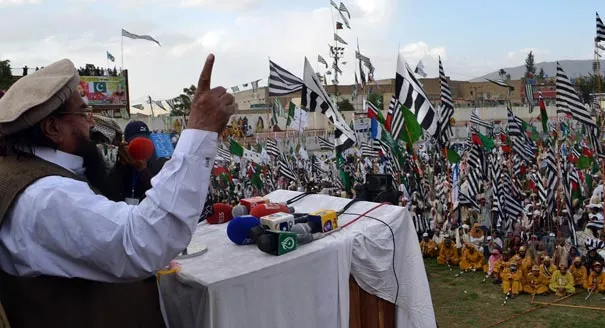
In early September 2026, Talha Saeed, son of Hafiz Mohammed Saeed, founder of Lashkar E Toiba (LeT) spoke at Khatam-e-Nabuwwat (Finality of Prophethood) conference in Sheikhupura, Punjab. “We are the people who have offered Bayah (oath of allegiance) of Jihad by the hands of the Noble Prophet Muhammed, the messenger of Allah” roared Saeed, claiming to continue Jihad in the path of Allah, till his last breath. Towards the end of his speech, Saeed referred to the Pakistan Army Chief Asim Munir as a someone who truly follows the words “faith, piety and jihad in the cause of Allah” which is the official motto of Pakistan Army.
Apart from his usual anti-India rhetoric, this is probably the first time, Saeed has openly praised Pakistan Army Chief Asim Munir in his speech. His fiery speech brough out some important messages which could be germane to understand the current relationship between LeT and the Pakistan army.
Mutual Dependence amid Survival Crisis
To begin with, the speech has come at a time when the Pakistan Army chief is being widely criticised for his actions in Pakistan, Pakistan Occupied Jammu & Kashmir (POJK) and in Balochistan. In August 2026, Jamiat Ulema-e-Islam (F) (JUI-F) chief Maulana Fazlur Rehman criticised Pakistan Army Chief Asim Munir for his hardline measures to tighten his grip over Pakistan politics.
This scathing criticism is a departure in the civil-military relationship in Pakistan which has had a smooth run till date. JUI-F is a Deobandi Islamist group with a sizable following in Pakistan and any change in tone and tenor from its leadership against the Pakistan army, is bound to have a negative impact on the ground.
Parallelly, violent unrests in Pakistan Occupied Jammu & Kashmir (POJK) have gone on unabated since May 2026. The Jammu Kashmir Joint Awami Action Committee (JAAC) has spearheaded these protests over governance, political rights and economic issues in POJK, inviting violent reprisals from the Pakistan Army. JAAC leaders have openly criticised Pakistan Army Chief Asim Munir, for his crackdown on peaceful JAAC protests.
Additionally, there have been increasing losses faced by the Pakistan Army in Balochistan and Khyber Paktunwa in the last few months. A report by the Pakistan Institute for Conflict and Security Studies, Islamabad highlights that Pakistan witnessed a sharp escalation in terrorist violence during September 2026, with the country recording its highest monthly number of terrorist attacks in last 12 years perpetrated by Balochistan Liberation Army (BLA) and Tehreek e Taliban Pakistan (TTP). On this front as well, the Pakistan Army Chief has been facing widespread criticism in light of the deteriorating situation in Balochistan and Khyber Paktunwa
Faced with rising criticisms on all fronts, Pakistan Army Chief appears to have reached out to the leadership of a terrorist group, Lashkar E Toiba (LeT) for its support, in order to prop it against other Islamists groups such as JUI-F and non-state players such as BLA, TTP and JAAC who have opposed him. Signs of this, were visible ever since May 2026 given the meetings between Talha Saeed and political leaders including ministers from the ruling dispensation. Later in July 2026, Talha Saeed was elevated to the leadership role amid confusion and internal tussle in LeT, ostensibly with blessings of Pakistan Army Chief Asim Munir.
This elevation and mainstreaming of Talha Saeed are believed to be a quid pro quo for the services of Talha Saeed to shore up the position of Pakistan Army Chief. Immediately after his elevation, Talha Saeed met Hafiz Tahir Mahmood Ashrafi, the chairman of Pakistan Ulema Council, believed to be close to the Pakistani establishment. Mahmood Ashrafi, one of the influential religious figures in Pakistan has openly supported Pakistan Army Chief at the same time being a critic of Maulana Fazlur Rehman, JUI-F. This meeting indicates that Pakistan Army has been attempting to create an unofficial alliance of Islamist groups pitting groups such as LeT, driven by Ahle Hadith ideology against Deobandi JUI-F.
Concomitantly, some of the LeT commanders have also spoken openly against TTP, supporting Pakistan Army Chief. One of the LeT’s senior ideologues Qari Yaqoob Sheikh lashed out at Kabul for harbouring TTP and warned of severe consequences. LeT vehemently opposes any claim of independence to Balochistan as sought by BLA.
Talha Saeed’s speech appears to have come at a time when there have been reports of severe resource crunch in LeT after Operation Sindoor in May 2025. Consequentially, by opposing groups which have been speaking or acting against the Pakistan Army and its chief General Munir in particular, LeT appears to placate Pakistan Army Chief to extract support for its own rebuilding efforts, which has been affected severely by Operation Sindoor.
It is believed that LeT has already started rebuilding structures inside its headquarters located at Muridke which were damaged during Operation Sindoor. At the same time, LeT is believed to have relocated some of its training camps to Balochistan and Khyber Paktunwa, to evade future punitive strikes from India in future and to also act against BLA and TTP, aiding Pakistan Army.
Additionally, LeT appears to be facing difficulties in recruitment as majority of its recruits are from POJK. The JAAC movement against the Pakistan Army has created challenges for LeT in recruiting in POJK in the last 6 months affecting its operations severely. That is all more reason for LeT to scout for greener pastures in Balochistan and Khyber Paktunwa.
To summarise, while General Asim Munir who is being criticised for his actions, appears to have leaned on LeT’s support in managing non-state actors in Balochistan and Khyber Paktunwa, LeT equally desperate, reeling from its setback since last May, has grabbed this opportunity with both hands. Talha Saeed’s elevation as the head of LeT, amid a leadership crisis, is the first indication of this tacit understanding.
Importantly, Talha Saeed’s latest speech in support of General Asim Munir only buttresses this tacit understanding. Both these events appear to highlight the quid pro quo between General Asim Munir and LeT. While General Asim Munir appears to be dependent on groups such as LeT to handle state subjects, Lashkar E Toiba appears to have increased its servility to please the Pakistan Army especially General Asim Munir, to stay in relevance in an ongoing survival crisis.
Dr V. Balasubramaniyan holds a PhD in Terrorism Financing from the Research Centre of Defence and Strategic Studies at Gurunanak College, Velachery, Chennai, Tamil Nadu, India. His research focuses on terrorism financing in India and its implications for national security. His areas of interest include terrorism, terrorism financing, geopolitics, economics, extremism, and deradicalisation. He has published articles in the Journal of Money Laundering Control, Defence Watch, CLAWS, Agni, and Aakrosh, and is a regular contributor to Geopolitical Monitor, Canada. He is currently an independent counter-terrorism specialist working with a range of institutional partners. He has also advised several organisations, including the Government of India.