
 Rajan Neema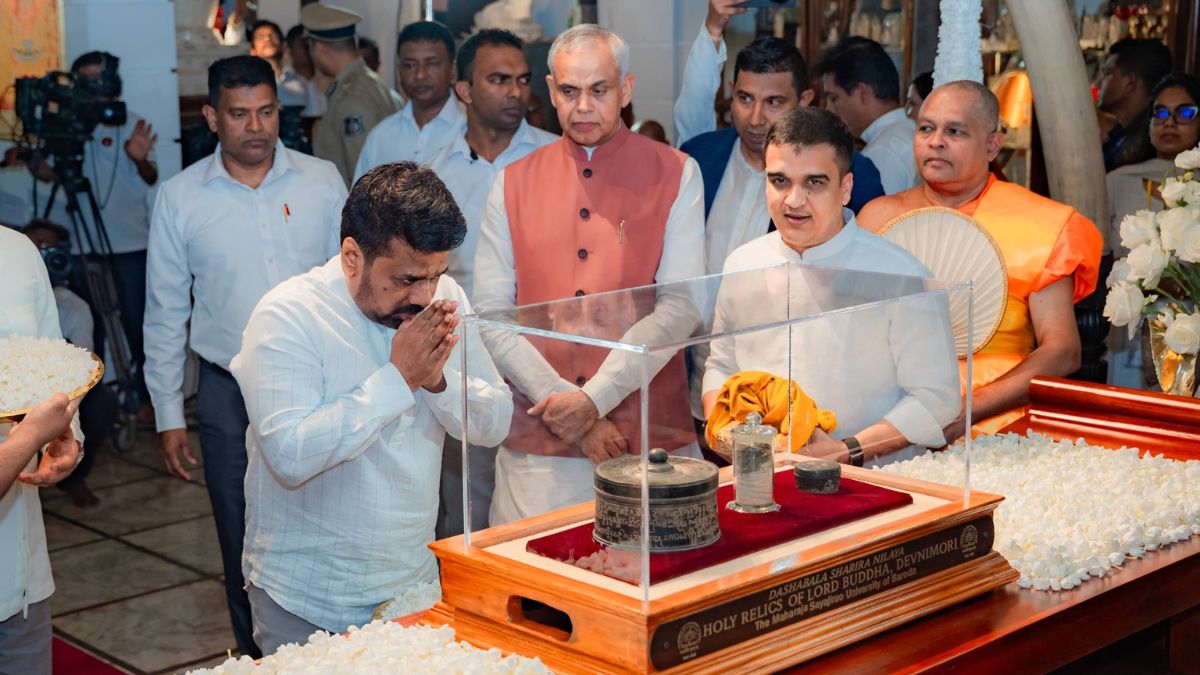
Introduction
Recently, in February 2026, India exhibited Sacred Devnimori Relics of Lord Buddha in Sri Lanka at the Gangaramaya Temple in Colombo, Underscoring centuries-old civilisational ties between the two countries. Before that, relics of Lord Buddha flew to Mongolia, Thailand, Vietnam have been key instances of India’s cultural diplomacy and have also signified cross-cultural communication.
The roots of relic diplomacy between India and Sri Lanka can be traced to ancient history. According to Buddhist chronicles such as the Dathavamsa and Mahavamsa, the Sacred Tooth Relic of the Buddha was preserved in Kalinga before being transported to Sri Lanka during the fourth century CE. Princess Hemamala and Prince Dantha are believed to have carried the relic to the island to protect it from political instability in India. Once established in Sri Lanka, the relic became a symbol of Buddhist faith and royal legitimacy. Sri Lankan rulers regarded themselves as guardians of the relic, and possession of it was closely associated with political authority. This transfer was not merely the movement of a sacred object but the beginning of a lasting cultural and religious connection between the India and Sri Lanka.
From Sacred religious symbol to powerful tool of diplomacy
The growing use of Buddhist relics in international engagement shows that sacred heritage is no longer confined to the religious arena. In contemporary Asia, relic diplomacy has acquired greater geopolitical significance. Countries are increasingly employing Buddhist symbolism, heritage exchanges, and relic exhibitions not only to deepen cultural bonds but also to cultivate political goodwill and regional influence. It is within this broader context that both India and China have sought to utilise Buddhism as an instrument of soft power.
Display of Buddhist holy relics through exhibitions in foreign lands is another key aspect of Indias cultural diplomacy. Buddhism has been a strong lynchpin in India’s cultural diplomacy with the world and the Asian region in particular. As Asia undergoes rapid geopolitical change, nations are increasingly rediscovering ancient cultural linkages. India’s outreach through Buddhism provides a positive and inclusive framework for regional engagement. Political scientist Joseph Nye popularised the term “soft power” to describe a nation’s ability to attract and inspire rather than coerce. Few countries possess as deep a reservoir of soft power as India. In the decades following India’s independence in 1947, Buddhism continued to be used as a diplomatic tool to varying degrees by different national leaders but it gained considerable traction in the 1990s with the launching of India’s ‘Look East Policy’ and its more recent iteration, the ‘Act East Policy’, under the Narendra Modi administration.[1]
Lately, China has been employing its custodianship of the tooth to great diplomatic advantage. The Chinese Communist Party has been engaging in Buddhist diplomacy essentially since its inception, as early as the 1950s. According to records cited by the Sri Lanka-China Buddhist Friendship Association, the relic was displayed in Sri Lanka in 1961 and has subsequently been exhibited in other South and Southeast Asian countries such as Myanmar and Thailand. Despite its officially atheist political system and a history of repression during the Cultural Revolution, it has sought to pose itself as a Cultural center of Buddhism, making it necessary to use Buddhism as a soft-power tool at the moment.
In past centuries the Silk Route played an important role in Buddhism’s transmission to Central Asia and Han China. Now China is turning to Buddhism to promote its own modern Silk Route, i.e., the Belt and Road Initiative (BRI), with increased Buddhist engagement and outreach directed toward Buddhist leaders and institutions across mainland Southeast Asia. The objective is to cultivate shared values and reinforce broader political and economic relationships. This strategy may appear simple on the surface but in reality, it is fraught with challenges and complications.
The issue of the Dalai Lama will remain one of the most sensitive issues among the Buddhists of South Asia. The controversial construction of the Lotus Tower in Sri Lanka, which was financed by Chinese loans, faced accusations of corruption and a lack of transparency. China may be expected to step up its Buddhist public diplomacy in cases where BRI projects encounter opposition in countries with large Buddhist populations. Sri Lanka’s experience is instructive in this regard: unable to repay huge loans it owes China for BRI projects; Sri Lanka has handed the Hambantota Port over to the Chinese authorities.[2]
However, Sri Lankans have raised concerns and expressed displeasure over China’s growing economic and political presence in the country, which is evident in the increased number of protests and opposition to Chinese sponsored projects. The impact of using Buddhism as a source of soft power remains unclear as the effects of soft power are not always immediately visible and works in positive way. Culture, ideology, values, and norms also often result in resentment, repulsion, hostility, and even conflict, primarily if a country pursues an aggressive cultural policy.[3]
Buddhism is being utilised by both countries as a form of image management and diplomatic leverage. On the one hand, Scott argues that Buddhism can serve as a generally ‘positive link in current China-India bilateral relations’, but it is also a ‘tool for competition’ as both rising Asian powers look to court influence among neighbouring countries and to position themselves strategically among prominent international Buddhist organisations. As India’s strength lies in its civilizational authenticity as the birthplace of Buddhism, whereas China’s influence is often reinforced through economic and institutional engagement.[4]
Conclusion
The journey of the Buddhist relics transferred from Kalinga to Sri Lanka demonstrates the enduring power of cultural heritage in shaping relationships across centuries. Today, relic diplomacy continues to serve as a valuable tool for strengthening India-Sri Lanka ties and projecting soft power in the wider region. While China has aimed to integrate Buddhist diplomacy with its economic and strategic outreach, India’s comparative advantage lies in its civilisational authenticity as the land where Buddhism originated, yet the success of relic diplomacy will depend not merely on the movement of sacred objects but on the ability to transform shared cultural heritage into lasting trust, people-to-people connections, and durable regional partnerships. In this sense, relics are not simply reminders of a common past they are also instruments for shaping the future of Asian diplomacy.
[1] Ian Hall, Modi and the Reinvention of Indian Foreign Policy (Bristol: Bristol University Press, 2019).
[2] H. Zhang, “Beyond ‘Debt-Trap Diplomacy’: The Dissemination of PRC State Capitalism,” China Brief 19, no. 1 (January 5, 2019), The Jamestown Foundation.
[3] Mingjiang Li, Soft Power: China’s Emerging Strategy in International Politics (Lanham, MD: Lexington Books, 2011).
[4] David Scott, “Buddhism in Current China–India Diplomacy,” Journal of Current Chinese Affairs 45, no. 3 (2016): 139–174.
Rajan Neema is a Researcher at India Foundation, New Delhi. He holds a Bachelor’s degree in Economics and Management from Devi Ahilya Vishwavidyalaya, Indore, and a Master’s degree in History from the Centre for Historical Studies, Jawaharlal Nehru University (JNU), New Delhi. He is UGC-NET qualified. Currently he engaged in a research project under the Indian Knowledge Systems (IKS) initiative of the Ministry of Education, Government of India.
 Dr. Yashwant Singh