 Dr. Yashwant Singh
A superpower is judged by whether its power produces outcomes, not by how much of it there is. By that standard, the Houthi movement of Yemen has become one of the harder tests of American credibility in a generation. It is not a test of American arms. No one believes the Houthis can defeat the US Navy. It is a test of American results, and so far the results are poor.
The cost-exchange problem
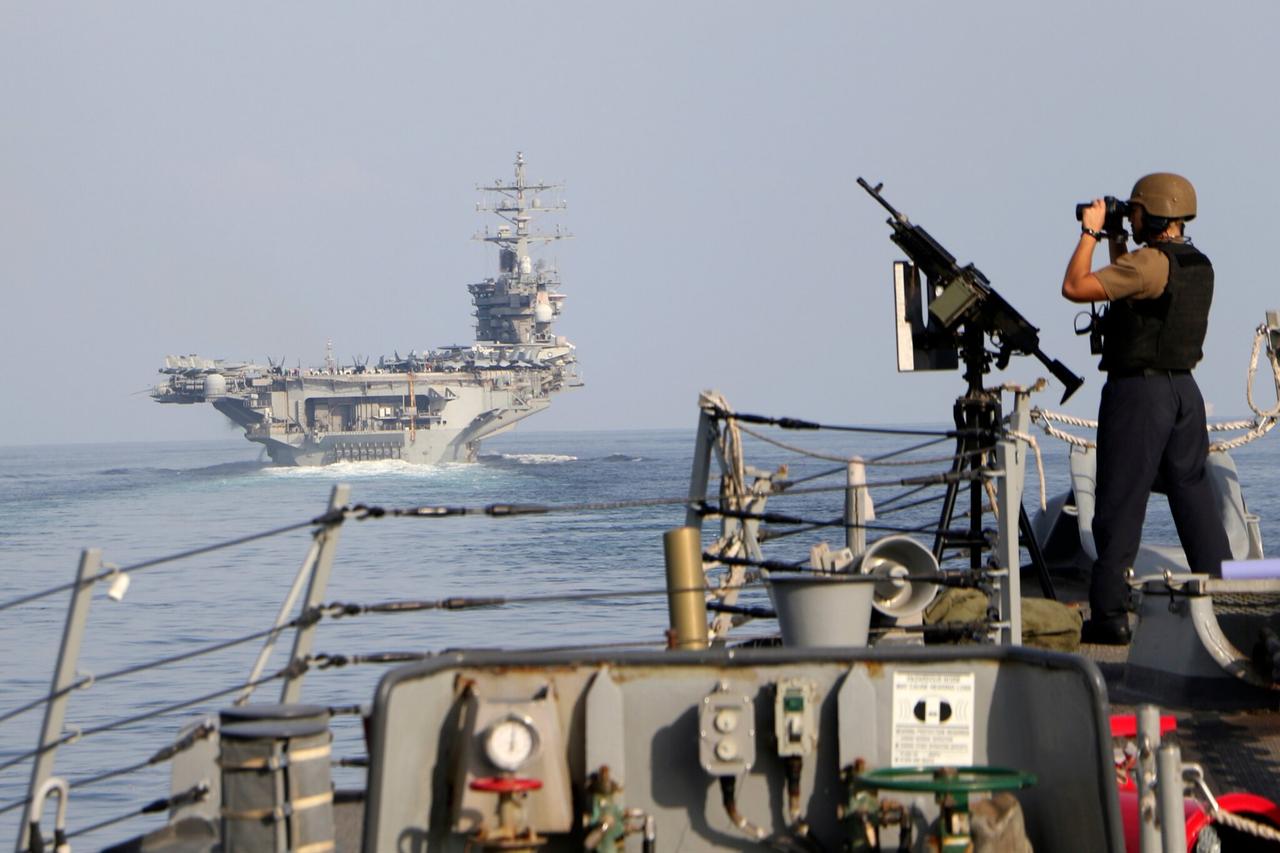
The Houthis hold the northern shore of the Bab al-Mandab, one of the world’s critical chokepoints, and they have learned that they do not need to win a naval battle. They only need to make the passage feel dangerous. Between November 2023 and October 2025, more than 100 Houthi attacks affected commercial vessels connected with more than 60 countries, according to the US Maritime Administration. Cheap drones and missiles forced insurers, shippers and navies to pay heavily to defend against them. Every interception of a cheap drone with an expensive missile is a small victory for the weaker side.
Two campaigns, no settlement
Operation Rough Rider, launched on March 15, 2025, struck hundreds of targets. Yet within two months Washington accepted an Omani-brokered truce under which the Houthis would stop targeting American ships. The truce protected American vessels, but it did not secure the sea lane or end the threat to everyone else’s shipping.
The Houthis read that outcome as survival, and survival against a superpower is a form of victory. Combined with the earlier multinational efforts to protect shipping, which also failed to end the attacks, Washington has twice applied force without producing a durable settlement. Neither episode was a military defeat. Both were political failures, and adversaries study political failures closely.
The crisis has moved on
The danger is now larger than shipping. After declaring a blockade of Saudi Arabia on July 20, the Houthis attacked Saudi Arabia directly and claimed attacks on eight Saudi-linked vessels in the Red Sea. In October, Riyadh’s airport was shut after a deadly strike, which killed 12 people and wounded over 300, and it stayed closed until October 17. Washington has told non-emergency personnel to leave the kingdom.
The timing makes this worse. Saudi Arabia is increasingly dependent on the Red Sea as an alternative oil export route, with Hormuz severely disrupted by the wider US-Iran conflict. The Houthis are therefore pressing on the one outlet that remains for energy supplies the world already struggles to secure. A movement once treated as a regional nuisance now threatens a pillar of the global economy.
Meanwhile, Washington’s posture has looked improvised. American officials said they had no immediate plans to strike, offering intelligence and targeting help to Riyadh instead. Reuters reported that US officials met Houthis in Oman, and that the group vowed to spare US and Israeli ships but not Saudi vessels. Whatever its diplomatic logic, an arrangement in which America’s ships are safe and its partner’s are not is a poor advertisement for American leadership.
Why air power is not enough
Those who demand renewed bombing misunderstand the adversary. The Houthis govern territory, including the capital, and run an administration. After years of civil war they are skilled at dispersing, hiding and rebuilding. A strike campaign can destroy launchers, but it cannot destroy the political order that produces new ones. Without a strategy behind them, strikes only repeat the pattern of 2025.
Nor is the problem Yemeni alone. The Houthis’ reach depends on Iranian technology and supply. Any plan that ignores that pipeline is treating symptoms.
What a serious strategy requires
The goal should be modest and clear: restore safe passage and make attacks on shipping costly. Overthrowing the Houthis would be a different and far more dangerous undertaking. Five elements follow.
First, make protection collective. European, Gulf and Asian states depend on the Red Sea more than America does. The US should lead a standing maritime coalition with shared costs and clear rules of engagement.
Second, back Saudi Arabia credibly. Intelligence support is useful, but an ally under direct attack needs air and missile defense, resupply and a visible US commitment.
Third, cut the supply chain. Interdiction at sea, sanctions enforcement and pressure on Iranian suppliers are less glamorous than bombing, and far more likely to reduce the Houthis’ capacity over time.
Fourth, pair force with diplomacy. The Omani channel is valuable, but it should be used from strength, with defined penalties for violations rather than open-ended tolerance. Hitting the Houthis’ ability to launch, and their revenue, should be a standing option and not a one-time spectacle.
Fifth, protect Yemen’s civilians. A humanitarian disaster would hand the Houthis a grievance and weaken the coalition’s legitimacy.
The question of credibility
Credibility is a stock of belief. Each unanswered attack draws it down, and each demonstrated ability to impose lasting consequences replenishes it. Other adversaries are watching to see whether a small, determined movement can hold a chokepoint hostage without paying a decisive price. If it can, they will try the same.
The answer is not a theatrical bombing run. It is a patient, coordinated and sustained campaign that treats the Red Sea as a strategic priority rather than a sideshow to other crises (particularly Iran and Hormuz). America does not need to prove it can destroy the Houthis. It needs to prove it can make the sea safe and keep it that way.
Dr. Yashwant Singh is a sociologist, recently served as an Assistant Professor in the Department of Sociology at GITAM (Deemed to be) University, Bengaluru, India. He holds an M.Phil. in Sociology from the University of Delhi and a Ph.D. in Sociology from the University of Hyderabad, India. His research interests include urban sociology, the sociology of development and geopolitics. His writings have appeared on several digital platforms, including Across Voices, Modern Diplomacy, Geostrategic Media, South Asia Journal, World Geostrategic Insights and IA-Forum.