You referred to a “meticulously coordinated terrorist onslaught that shattered Bangladesh’s foundations by overthrowing the legitimate government of Prime Minister Sheikh Hasina. As the country burned and order collapsed, Muhammad Yunus emerged as the usurper.” How should one interpret this sudden transformation of Bangladesh, from a secular republic to a state now viewed through the prism of terror?
This must be understood as a setback not only for Bangladesh but for humanity as a whole in the 21st century. The devastation caused by eighteen months of Yunus’s usurped rule has undone decades of progress. It has destroyed an economy painstakingly rebuilt under Sheikh Hasina and has systematically dismantled Bangladesh’s secular identity, historical memory, and the moral legacy of its Liberation War. This is not merely political regression; it is civilizational vandalism.
You argue that Bangladesh has “descended into terror” under Yunus. Yet for years he was celebrated in much of the Western world as a liberal icon. How do you explain this shift? Was he compelled into alliances with extremist forces, or was this his true nature revealed?
This is not a transformation. This is the real Yunus. Those of us who followed him closely always knew he was a swindler, an international charlatan skilled at charming Western patrons by blinding them with rhetoric and reputation. What has happened now is not a fall from grace; it is confirmation. Events have merely proven what many already knew.
Amid uncertainty over Bangladesh’s democratic future, Yunus has declared that the people are ready for “the most beautiful election in our history.” What is your assessment of these elections, including the referendum, given that the Awami League has been banned by the interim government?
Like everything Yunus calls “beautiful,” this election is among the ugliest in Bangladesh’s history, and that is not hyperbole. Yunus has long survived by repackaging the grotesque as virtue. This time, he will not get away with it.
What is being staged is not an election but a contest between two factions of the 2024 jihadist coalition that seized the state by overthrowing Prime Minister Sheikh Hasina. On one side is the BNP and its allies; on the other, Jamaat and its partners. Ideologically, BNP resembles Egypt’s Muslim Brotherhood, if not structurally, while Jamaat is comparable to Hamas in Palestine. Neither is democratic. Both are Islamist and extremist.
No genuinely democratic party has been permitted to contest. Yunus is openly maneuvering to control the outcome so that he remains central to the next government. His preferred partners are Jamaat and its affiliates, including the NCP, whose cadres acted as suicide operatives during the 2024 jihadist violence disguised as the so-called quota movement. Add to this the involvement of foreign actors, particularly in the West, searching for the most obedient proxies.
Call it an election if you wish. It is nothing of the sort.
From your perspective, what future do you foresee for Sheikh Hasina’s Awami League, a party with historic ties to India?
History and civilization are on the side of Sheikh Hasina and the Awami League. At present, they may not be playing their rightful role, but the deeper forces of history and civilizational truth favor them. Their eventual return is inevitable. How long that takes will depend on how Sheikh Hasina and the Awami League choose to act.
“India First” has often been described as a pillar of Bangladesh’s foreign policy. Under Sheikh Hasina (2009–2024), cooperation with India deepened despite unresolved disputes. Today, however, anti-India sentiment appears widespread. What forces are driving this shift?
The idea that “India First” defined Bangladesh’s foreign policy is a simplification. Bangladesh has always existed as two Bangladeshs. One is the Bangladesh of the Liberation War, led by the secular Awami League. The other is the anti-liberation, pro-Pakistan Bangladesh led by Jamaat and the BNP.
Because of their ideological inheritance, these forces label the Awami League as “pro-India,” exploiting the historic bond forged between India and freedom-loving Bangladeshis in 1971. Through sustained propaganda, they succeeded in dislodging the Awami League by falsely claiming it had “sold Bangladesh to India.”
Anti-India sentiment today is largely sectarian, cultivated through the culture of waj-mehfil, which routinely demonizes Hindus and other minorities. The Awami League failed to confront this poison forcefully enough. India, for its part, also displayed a lack of strategic wisdom. Together, these failures created the conditions you see today.
BNP leader Tarique Rahman promotes a policy of “Bangladesh First.” Many believe the real test for India–Bangladesh relations will come after the election. From a diplomatic standpoint, what trajectory do you foresee?
Relations will largely follow the pattern established under Yunus’s rule: brief warming if the BNP comes to power, followed by inevitable deterioration. For historical, ideological, and sectarian reasons, neither faction of the 2024 jihadist coalition, whether BNP or Jamaat, is capable of sustaining a healthy relationship with India. Their politics simply do not allow it.
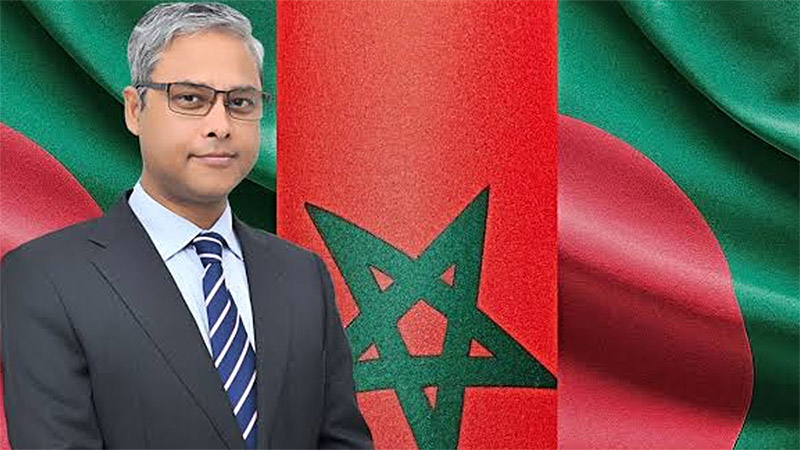
Mohammad Harun Al Rashid is a seasoned Bangladeshi career diplomat from the 20th batch of the Bangladesh Civil Service (Foreign Affairs) cadre, having joined in 2001. He was appointed Ambassador of Bangladesh to the Kingdom of Morocco on 11 October 2023, following earlier assignments as Minister and Deputy High Commissioner at the Bangladesh High Commission in Ottawa, Canada, and postings in Rome, Cairo, Mexico City, and Madrid.
In December 2024, he was recalled by the Ministry of Foreign Affairs but did not return to Dhaka. In March 2025, while serving as Ambassador in Morocco, he publicly criticized the Muhammad Yunus–led interim government, accusing it of fostering instability. Following these remarks, the Bangladeshi authorities canceled his and his family’s passports. Facing political pressure, Mr. Al Rashid sought asylum in Canada, where he now resides in exile. He continues to voice opposition to the interim administration through international media, portraying himself as a persecuted diplomat advocating for Bangladesh’s democratic stability.