At the heart of Sri Lanka’s evolving political landscape lies a crucial question: what insights did Mr.Tilvin Silva, General Secretary of the Janatha Vimukthi Peramuna (JVP), gain from his first official visit to India? Undertaken through the Indian Council for Cultural Relations’ (ICCR) Distinguished Visitors Programme from 5–12 February 2026, the visit carried both symbolic and practical significance.
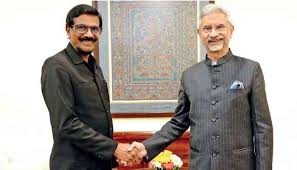
During his time in India, Silva held discussions with External Affairs Minister Dr. Jaishankar and toured Gujarat and Andhra Pradesh—states often highlighted as showcases of India’s economic and technological progress. His reflections revealed a nuanced mix of opportunity and challenge. On one hand, he observed that India’s emphasis was firmly on development and innovation rather than exerting political pressure to push Sri Lanka toward the long-delayed Provincial Council elections.
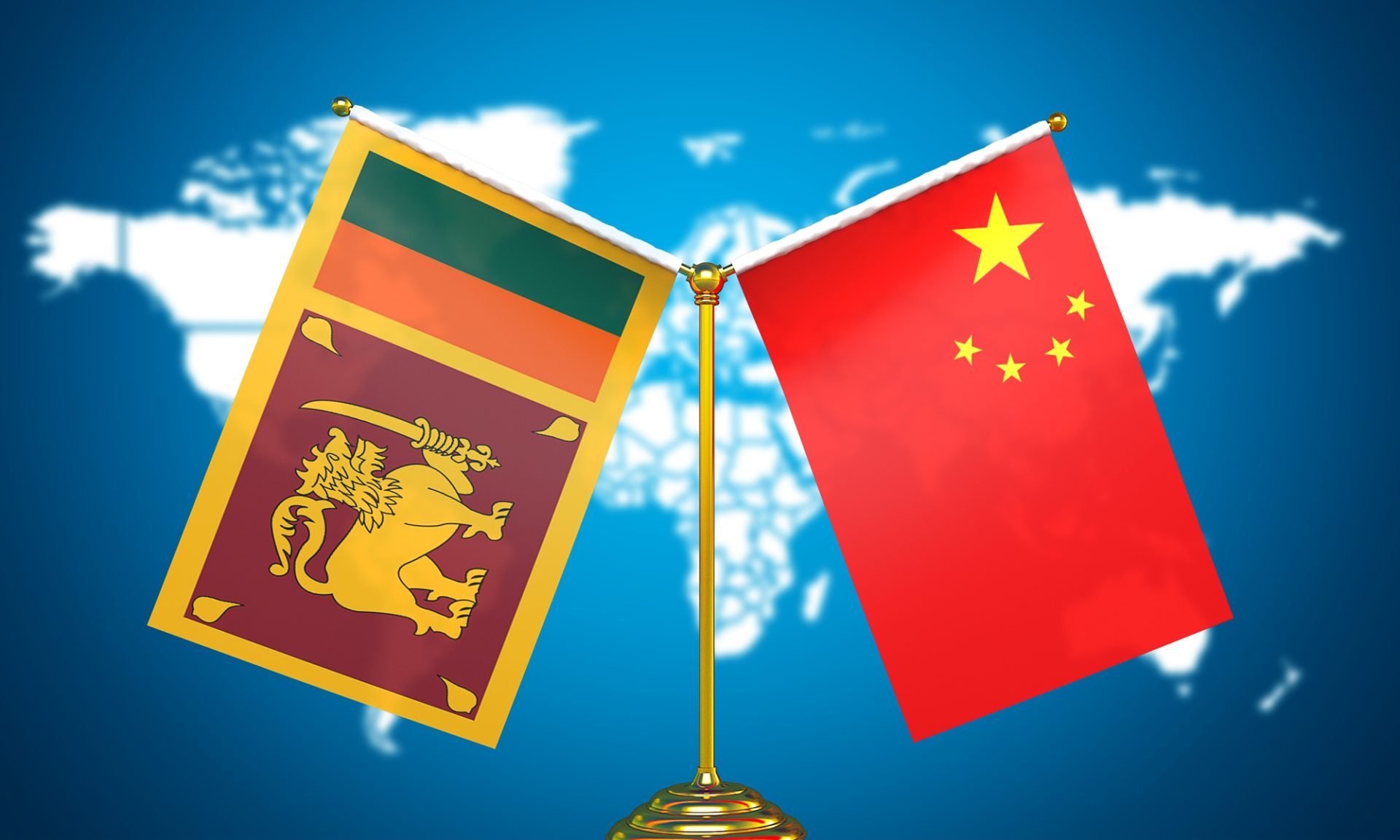
On the other, his comparisons between India and China raised broader questions about which model Sri Lanka should look to as it charts its own future. Silva noted: “In India, we see that though there are efforts to introduce new technology, there have been some obstacles in implementing these initiatives because there are religious and cultural practices and traditions that have to be navigated. In China, it is not like that.”
Silva’s stance on Provincial Council elections remains ambiguous. When the discussion turned to the Tamil question during his stay in India, he emphasized that he was there in his capacity as the JVP’s General Secretary, representing the party rather than the government. At the same time, he has consistently characterized the provincial council system as a failed model. This raises an important consideration: should his remarks be understood as reflecting the party’s position, or as signaling the policy direction of the government?
The issue is not whether India is exerting pressure, but whether Sri Lanka would hold Provincial Council elections in the absence of such external influence. Silva believes that if the JVP is to act as a “responsible government,” it must conduct elections and ensure balanced economic development across all provinces.
India’s position on the 13th Amendment and devolution of power has long been clear. As Dr. S. Jaishankar stated in 2021: “It is in Sri Lanka’s own interest that the expectations of the Tamil people for equality, justice, peace, and dignity within a united Sri Lanka are fulfilled. That applies equally to the commitments made by the Sri Lankan Government on meaningful devolution, including the 13th Amendment.”
India’s stance is not a ‘proxy’ for Tamil demands, but rather the responsibility of a neighbor with more than 85 million Tamil-speaking people in South India. Ensuring Tamil rights in Sri Lanka, India argues, benefits Sri Lanka itself, not India.
Tamil parties in Sri Lanka have repeatedly appealed to New Delhi, arguing that Colombo neglects its responsibilities. Their perennial appeals reflect a political reality: when Sri Lanka fails to act, Tamil parties turn to India. During Prime Minister Modi’s visit to Colombo last year, Tamil parties once again urged India to intervene to ensure Provincial Council elections as part of meaningful devolution.
Opponents of power sharing often interpret India’s involvement in the Tamil national question to suit their own narratives. Yet the fact remains: Tamil parties have consistently sought Indian intervention because of Colombo’s neglect.
Against this backdrop, suspicions have grown that the JVP-led NPP may seek to abolish the provincial council system altogether. The JVP’s history reinforces such concerns. In the past, its anti–provincial council campaign escalated into violence, including assassinations of supporters of the 13th Amendment.
Tamil leaders recently met Dr. Jaishankar in Colombo, urging him to insist on elections. Their appeals were directed not only at India but also at Silva, who was due to arrive in New Delhi.
According to the JVP, this marks the third phase of its journey in power politics. JVP1 and JVP2 have been widely analyzed, with JVP2 characterized by Marxist rhetoric, Sinhala nationalism, and anti-Indian sentiment. Silva himself admitted: “I explained to officials at the Indian High Commission that this opinion needs to change. We still have the ‘five classes’ in our political education, but there is none about India specifically.”
Yet the party once opposed the Indo-Lanka Accord and branded Indian-origin Tamils as a “fifth column instrument of Indian expansionism.” If the JVP now believes both India and itself have changed, the question remains: why resist a provincial council system modeled on India’s framework for power sharing?
India’s federal system offers important lessons. Tamil Nadu once demanded separation, led by E.V. Ramasamy Periyar in the 1930s. His disciple C.N. Annadurai carried the idea into politics. But by 1967, following the Sino-Indian war and the 16th Amendment, Tamil Nadu abandoned separatism.
Today, Tamil Nadu is India’s second-largest economy, ahead of many northern states. Its development is so distinctive that it is often called the “Tamil Nadu model.” This success was achieved through effective provincial governance, not separatism.
Tamil Nadu’s journey shows that power sharing can strengthen unity while fostering regional development. The slogan once popular in Tamil Nadu — “the North flourishes and the South wanes” — has been overturned by reality. Today, Tamil Nadu thrives, proving that provincial governance can deliver prosperity.
These are the lessons the JVP should take from India. A political environment must be created in Sri Lanka where provinces beyond the Western Province can contribute equally to economic growth. Power sharing should not be viewed solely as a Tamil issue, but as a national development strategy.
India’s system is not built on ethnicity or religion, but on inclusive development. For a multilingual democracy like Sri Lanka, power sharing is the best path forward. In contrast, a totalitarian model like China presents a very different reality.