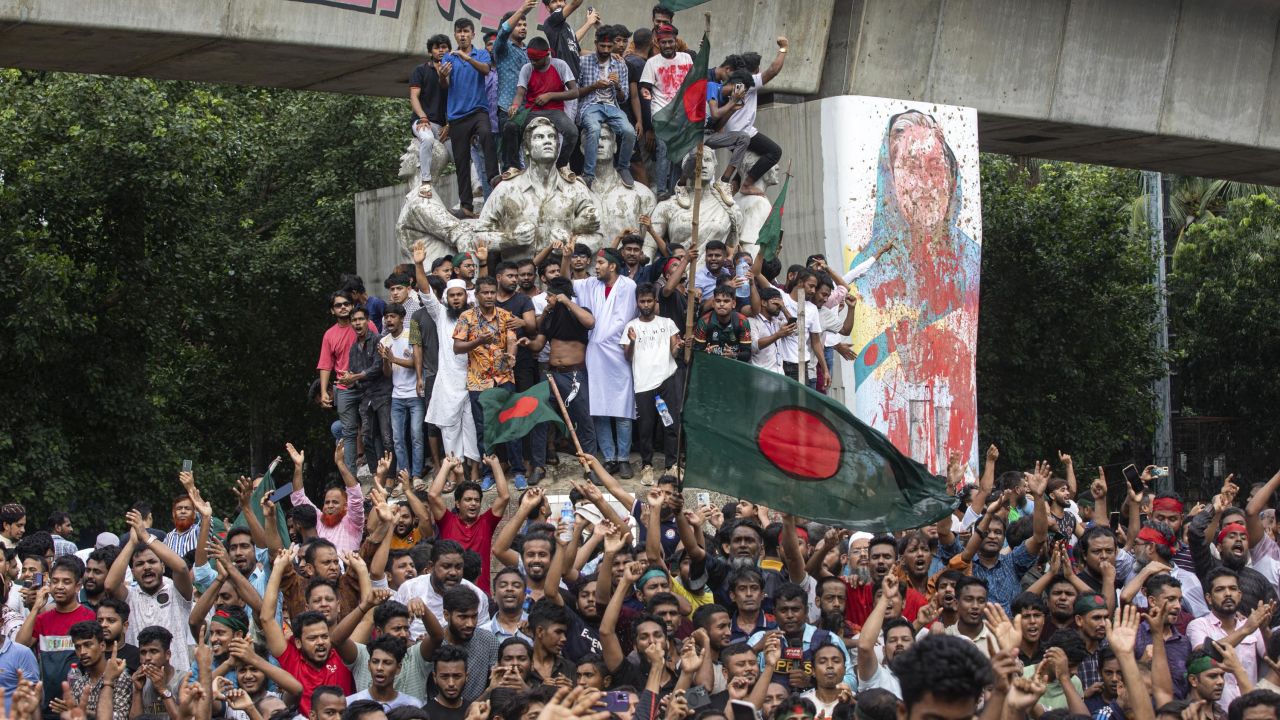
The current unrest in Bangladesh poses a pressing geopolitical question: is the country drifting out of India’s strategic orbit? A significant rift emerged in August 2024 when Sheikh Hasina—long the political cornerstone of India–Bangladesh relations—was removed from power. This followed an uprising in which student protests over employment quotas escalated into widespread violence against her government, ultimately forcing her to flee and seek shelter in India.
Since Hasina’s departure, Bangladesh’s politics have been shaped by a mix of nationalism, Islamic fundamentalism, and growing anti-India sentiment. Violence flared again after the killing of radical activist Sharif Osman Hadi, a prominent figure in the 2024 movement to oust Hasina.
Hadi, founder of Inqilab Mancha (Platform for the Revolution) — a radical student group at Dhaka University — was known for his anti-India views and advocacy for a “Greater Bangladesh.” Some believe his death triggered massive anti-India protests and renewed calls to “free” India’s northeastern states from New Delhi’s control. After his death, a Facebook post read: “In the struggle against Indian hegemony, Allah has accepted the great revolutionary Osman Hadi as a martyr.”
Hasina accuses the Yunus administration of undermining the country’s founding principles and pursuing a reckless foreign policy that threatens regional stability. She says his actions not only distort Bangladesh’s history but also endanger its secular and constitutional foundations. After the Nobel laureate Muhammad Yunus–led administration assumed power, it moved quickly to curb Hasina’s political influence. While requesting Hasina’s extradition from India, the interim government amended the International Crimes Tribunals Act of 1973 by administrative order in November 2025 to broaden its scope and allow for her prosecution. Hasina was later sentenced to death in a trial held in absentia — a development critics say reflects politicization of the judiciary.
In 2013, several leaders of Jamaat‑e‑Islami were convicted, and a number of top figures who had served as Razakar or Al‑Badr commanders in 1971 were executed; the party was then banned. After Hasina’s ouster, the Supreme Court overturned the cancellation of Jamaat‑e‑Islami’s registration, allowing it to operate again as a political party. Under pressure from Jamaat and other Islamic fundamentalist groups, the Yunus interim government then banned Hasina’s party, the Awami League. This suggests that fundamentalists are using Yunus systematically to erase the pro‑India influence of the “Mujib family” ahead of the elections.
Bangladesh’s move away from secular, nonpartisan politics — even if it looks like a domestic shift — will have clear geopolitical consequences. It strengthens a Pakistani–Chinese alignment hostile to India and embeds a new, anti‑India element in Bangladeshi statecraft.
Under Yunus’s administration, evidence points to Bangladesh becoming a growing hotbed of anti‑India sentiment. Yunus is not a seasoned statesman; he was appointed to placate the fundamentalist student uprising, and in that role he appears to be strengthening the very forces that brought him to power.
Yunus has promoted the idea of a “Greater Bangladesh,” which purportedly includes parts of Assam, Tripura, West Bengal, Jharkhand, Odisha, and Bihar in India, as well as the Arakan region of Myanmar. This has led some to portray him as an agent of global Islamist movements like the Muslim Brotherhood in Bangladesh.
Against this backdrop, Yunus’s actions reflect the anti-India agenda of pro-Pakistan fundamentalists. This is illustrated by a book he recently presented to a visiting Canadian delegation; its cover features a map of Bangladesh appearing to encompass large parts of India’s northeast — a symbolic gesture intended to globalize the anti-India narrative. Earlier, he presented the same book to a visiting Pakistani army general.
Yunus’s first visit to China after taking office marked a clear break with Bangladesh’s previous India-centered approach. In Beijing, he called on China to expand its influence in South Asia, saying India’s seven northeastern states remained “landlocked” and “have no access to the ocean”; he added, “we are the only guardian of the ocean for this entire region.” The trip reflected a policy shift following the rise of anti‑India, pro‑Pakistan forces after Hasina’s ouster. In a notable development, Beijing invited for the first time a senior Jamaat‑e‑Islami figure — Syed Abdullah Muhammad Taher, an important contender in next year’s elections. “It was an excellent trip; they treated us as government dignitaries,” Taher said.
Taher is the former head of Islami Chhatra Shibir, viewed as Jamaat’s extremist student wing. Beijing’s reception suggests it is aware that Jamaat could gain power or exert major influence after the elections. For China, this looks like a “pincer movement” against Indian influence during Bangladesh’s political transition.
The recurrence of violence has led to scrutiny of the government’s response. Some analysts attribute the perceived inaction to the significant political sway held by fundamentalist religious groups. This perspective is echoed in regional discourse; for instance, a Dhaka-based journalist suggested that Pakistan, having waited for such an opportunity for decades, could seek to utilize Bangladesh’s forthcoming electoral process to institutionalize radical Islamic networks that could threaten India’s security — thus continuing a long-standing strategic rivalry.
Fifty-five years ago, in the general election of December 1970, the Awami League secured a decisive mandate by winning 160 of the 162 seats in East Pakistan, establishing the political foundation for the creation of Bangladesh. Looking ahead to the forthcoming election in February 2026, observers note that a strong performance by political actors such as the Pakistan-aligned Jamaat-e-Islami and its affiliates could influence Bangladesh’s political trajectory. Such a shift in the political landscape may pose significant and direct security implications for India, potentially opening a new front of strategic concern.
 Dr. Yashwant Singh