The involvement of foreign troops in disaster relief efforts in Sri Lanka underscores how real-world circumstances continually shape the dynamics of geopolitics. It also serves as a striking example of how such realities can compel ruling elites in smaller nations to shift away from their textbook ideologies. Mr. Anura Kumara Dissanayake, who now serves as the executive president and has welcomed foreign forces on the ground to assist the nation, once vehemently opposed the presence of U.S. military personnel on Sri Lankan soil. In 2009, as a JVP Member of Parliament, he claimed that the United States was planning to establish a missile base at the strategically vital naval port of Trincomalee. These allegations arose during a visit by the U.S. Pacific Fleet Command, led by Major General Thomas L. Conant, ostensibly to oversee a school rehabilitation project in the eastern province—a project funded jointly by the U.S. Pacific Fleet Command and USAID.
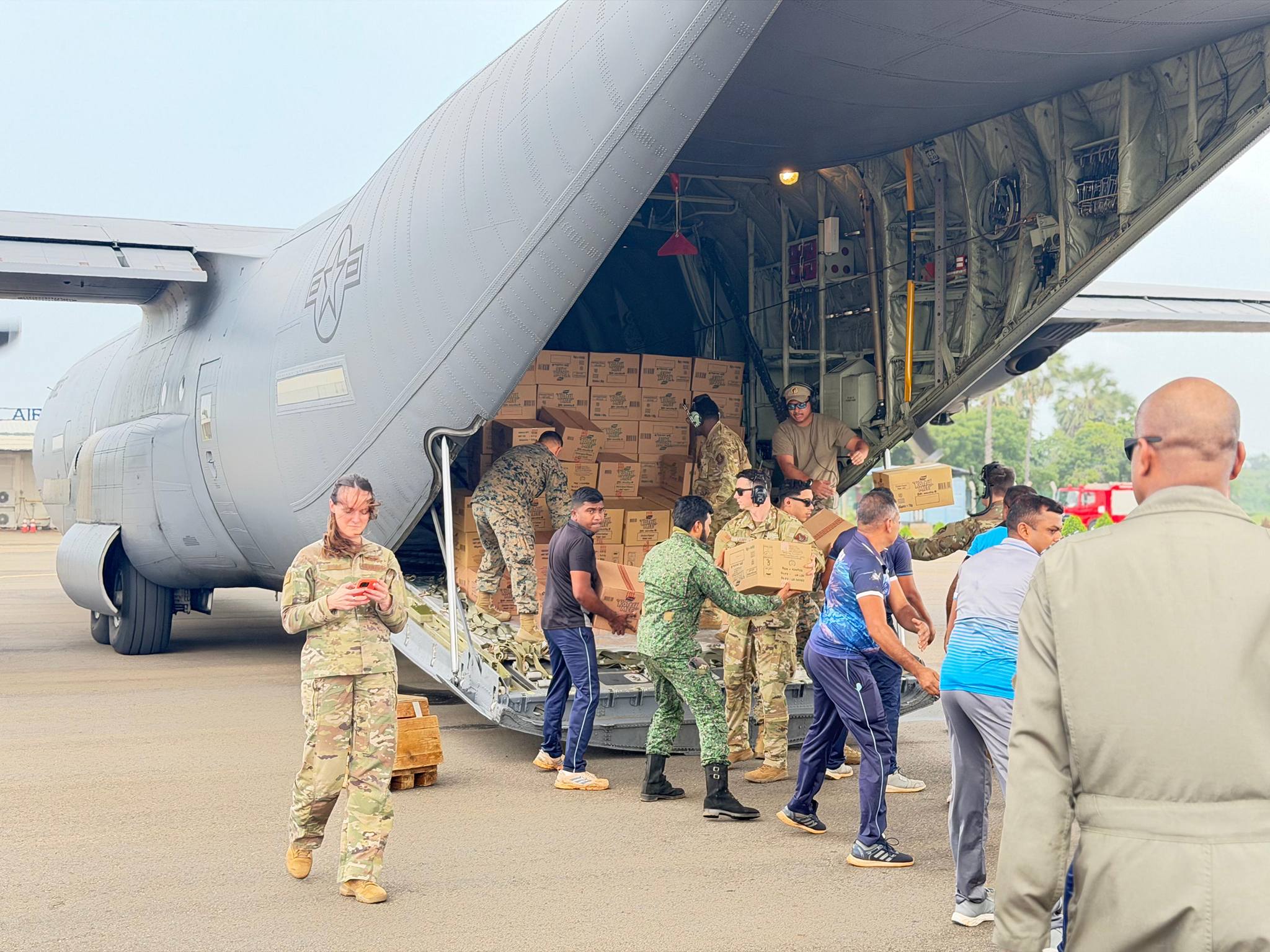
The presence of U.S. soldiers overseas is a common sight, but their deployment on Sri Lankan soil is a rare occurrence. For the first time in the country’s history, both Indian and American troops are actively involved in rescue operations within Sri Lanka. As part of the ongoing Sri Lanka–U.S. defense collaboration, Trincomalee hosted the Cooperation Afloat Readiness and Training (CARAT) Sri Lanka 2024 exercise on April 21, 2024. This program has united the U.S. Navy, Marine Corps, and Sri Lanka Navy to enhance maritime security capabilities. The operation also includes joint efforts between the U.S. Fleet Anti-Terrorism Security Team (FAST) and their Sri Lankan naval counterparts.
Further strengthening bilateral relations, a Memorandum of Understanding (MOU) was signed on November 14, 2025, formalizing a defense partnership between the Montana National Guard, the U.S. Coast Guard District 13, and Sri Lankan Armed Forces. This agreement reinforces a shared commitment to regional stability and maritime security in the Indo-Pacific.
Looking back, New Delhi has historically been wary of American troops setting foot in Sri Lanka, perceiving such a move as a threat to India’s national security. During the peak Cold War era, suspicions ran high that President J.R. Jayewardene was covertly negotiating to grant Trincomalee port—a highly strategic naval location in Sri Lanka’s Eastern Province—for an American military base. Although this era has since transitioned away from the divisive politics of the Cold War, the narrative of the U.S. eyeing Trincomalee remains a recurring flashpoint in Sri Lankan political discourse.
The story resurfaced in 2019 when the aircraft carrier USS John C. Stennis operated near Sri Lanka, utilizing the Bandaranaike International Airport for temporary cargo transfers. Similar allegations reemerged in October 2025, when a former Sri Lankan minister claimed that agreements had been made to establish a U.S. naval base in Trincomalee.
During the Cold War, President J.R. Jayewardene’s pro-American stance provoked significant concern in Delhi, which was led by Indira Gandhi at the time. According to Professor Rohan Gunaratna’s book, “India’s Intervention – The Role of India’s Intelligence Agencies,” R.N. Kao, the first director of India’s Research and Analysis Wing (RAW), noted, “Sri Lanka became a seat for outside influence we considered not very friendly toward us. Naturally, it caused some concern.”
These fears were further amplified in 1981 when Jayewardene lifted a nine-year ban on foreign warships in the Trincomalee harbor, allowing U.S. naval vessels to refuel there. India saw this as a covert step toward transforming Trincomalee into an American naval base, undermining its regional hegemony. Adding to the mistrust was Sri Lanka’s growing connection with Israel, which also raised suspicions in Delhi. Gunaratna’s book recounts Jayewardene’s strong response to Gandhi’s objections: “When Mrs. Gandhi told me to send the Israelis away, I told her that I will do so if she closed the Israeli consulate in Bombay.”
Amid heightened Cold War tensions, Mrs. Gandhi adopted a firm stance against J.R. Jayewardene’s perceived alignment with the West, which she believed undermined India’s position in the region. According to Gunaratna’s findings, Gandhi had even devised a secret plan to invade Sri Lanka. By August 1984, the Fifteenth Independent Paratroopers Brigade of the Indian Army was reportedly prepared to seize Sri Lankan airstrips. This plan came to light when secret Indian defense files outlining the invasion strategy were leaked to the press by a French agent. This incident underscores how intolerable Sri Lanka’s alignment with the United States was to Delhi.
India’s concerns led it to directly intervene in Sri Lanka’s internal affairs, including the covert arming and training of Tamil militants. This intervention ultimately culminated in the Indo-Sri Lankan Accord of 1987. In retrospect, one might argue that if J.R. Jayewardene had avoided antagonizing India and instead recognized Mrs. Gandhi’s regional leadership, the situation could have been managed diplomatically. Later, reflecting on these events, J.R. acknowledged the dangers of alienating India. Speaking to the Times of London prior to signing the Indo-Sri Lankan Accord, he confessed, “I had turned to many countries for military help, but none had been forthcoming”.
Today, the geopolitical landscape has undergone a profound transformation. India and the United States, once entrenched in the adversarial, Cold War-era politics of opposing spheres, have now become, in Obama’s words, “indispensable partners.” While India does not align with every U.S. initiative on the global stage—for instance, its stance on Russia—its attitude toward American activities in the region has notably softened. Additionally, India has developed very close ties with Israel, further reflecting its evolving foreign policy priorities.
The image of Indian and U.S. troops working side by side during Sri Lanka’s historic floods highlights this evolving partnership and their shared commitment to tackling challenges in the Indo-Pacific.
As Sri Lanka navigates its path forward, one undeniable truth remains: foreign influence, whether visible or invisible, continues to be an inextricable aspect of its political reality.