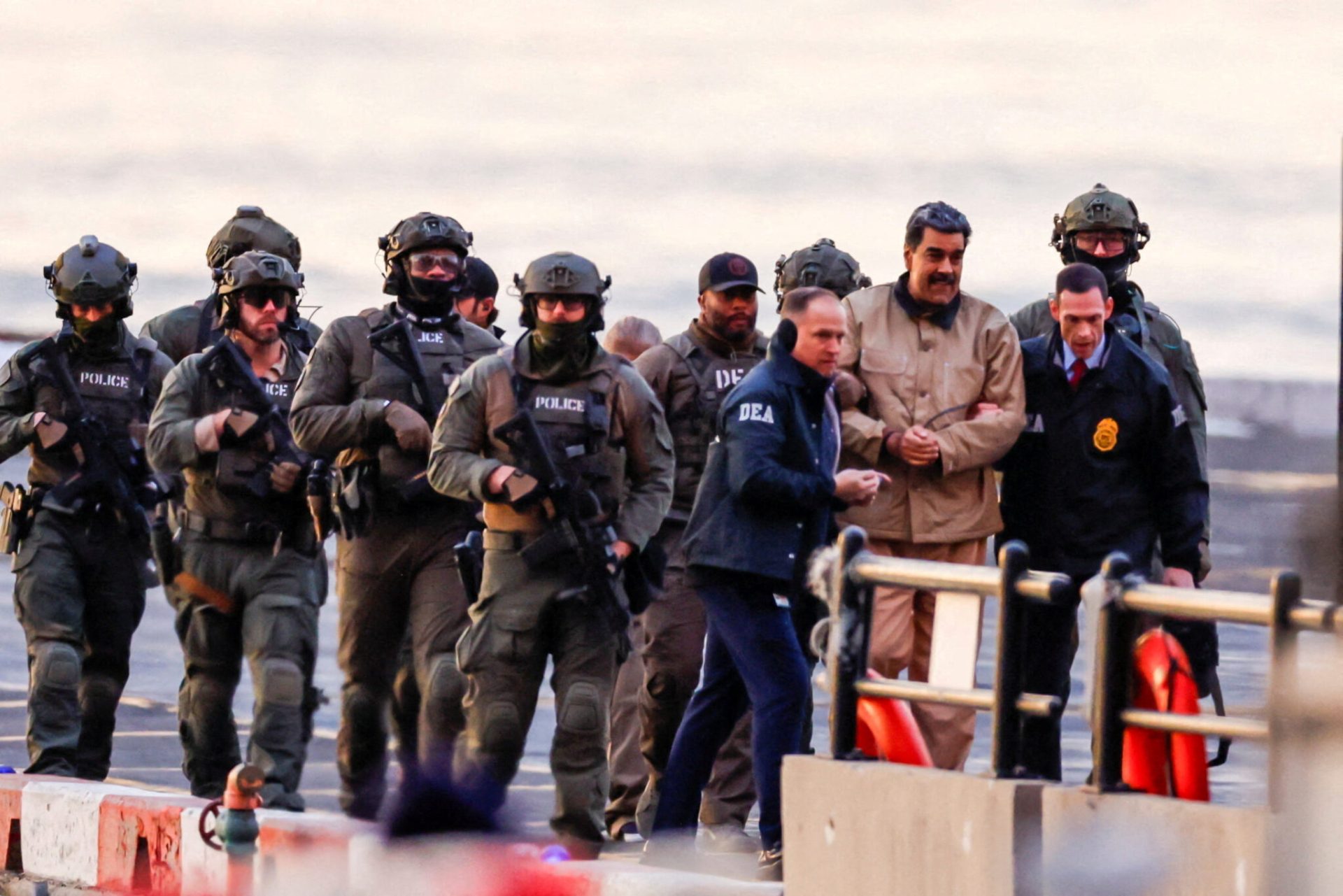
The recent U.S. military operation against Venezuela and the capture of President Nicolás Maduro have sparked sharp criticism and condemnation. Maduro now awaits trial in New York City. Once again, it is evident that international politics is not guided by international law but by the interests of great powers and their alliances. Some critics, even within the United States, have described this as President Trump’s “Putinization of U.S. foreign policy.” Yet the deeper question is whether any individual president can override America’s institutional structures and act against national interests—or whether such actions reflect a broader continuity of U.S. hegemony in the region.
Historical Parallels: Panama and Venezuela
History offers striking parallels under the great-power rivalry. In 1989, President George H. W. Bush ordered the invasion of Panama, capturing dictator Manuel Noriega and indicted him under U.S. law. The Bush administration justified the intervention on grounds of Panama’s violations of the canal treaty, drug trafficking, and the killing of a U.S. Marine officer. During the election in 1989, Noriega had annulled election results and installed a classmate as president, prompting Washington to act decisively.
Thirty-six years later, President Trump has taken a similar course against Venezuela. The criticism has been just as widespread, with the United Nations condemning the move as a violation of sovereignty. True to form, Washington showed little concern for such objections. As Asanka Abeyagoonasekera points out, the situation appears to be managed on the basis of “act first, stabilize later.” Yet, as with Panama and Iraq, this episode may soon fade amid new waves of political turmoil.
The parallels are not exact. In Panama, Noriega’s national assembly declared war on the United States. In Venezuela, Maduro’s regime retained power through fraudulent elections, echoing Noriega’s tactics but without a formal declaration of war. In both cases, however, military action followed failed economic and diplomatic pressure. Reagan’s administration had tried to persuade Noriega to step down through diplomacy, but Bush—then vice president—opposed compromise. Similarly, Washington had long pressured Maduro through sanctions before resorting to force.
Venezuela’s Path to Confrontation
Venezuela’s troubled relationship with the United States dates back to Hugo Chávez’s rise in the 1990s. His socialist agenda and anti-American rhetoric enhance ties with China, Iran and Russia strained ties with Washington, and a U.S.-backed coup attempt in 2002 failed to remove him. After Chávez’s death in 2013, Nicolás Maduro carried forward his predecessor’s policies, deepening the crisis. Maduro retained power through fraudulent elections in 2018 and again in 2024, despite widespread opposition. By late 2025, Trump warned Maduro to step aside, but with sanctions failing to secure a smooth transition, Washington opted for regime change by force.
On the surface, Washington’s surprise move appears aimed at controlling the world’s largest proven oil reserves in Venezuela. But at a deeper level, it is about asserting control over the Western Hemisphere. The growing Chinese presence in Latin America is a serious concern in Washington. U.S. Secretary of State Marco Rubio underscored this when he declared: “This is the Western Hemisphere. This is where we live—and we’re not going to allow the Western Hemisphere to be a base of operation for adversaries, competitors, and rivals of the United States.” Maduro’s capture came just hours after he met with Chinese diplomats to reaffirm their strategic partnership.
In 2017, Trump’s National Security Strategy (NSS) announced a U.S. focus on great-power competition, principally with China, marking a shift after decades of Middle Eastern preoccupation. The removal of Maduro aligns with the broader strategic shift outlined in the NSS released in December 2025. The document underscores the intervention as emblematic of a revived Monroe Doctrine, reframed as the “Trump Corollary”: “After years of neglect, the United States will reassert and enforce the Monroe Doctrine to restore American preeminence in the Western Hemisphere… We will deny non-Hemispheric competitors the ability to position forces or control vital assets in our Hemisphere.”
The Monroe Doctrine and Its Legacy
The Monroe Doctrine, first articulated in 1823, warned European powers against interference in the Americas. Theodore Roosevelt expanded it in 1904, asserting U.S. “international police power” to quell unrest in the region. Franklin D. Roosevelt later attempted a “Good Neighbor” policy of non‑intervention, but Cold War realities prevented Washington from adhering strictly to this principle.
The CIA waged a shadow war, orchestrating coups and toppling several heads of state across Latin America to block Soviet influence. Against this backdrop, Venezuela is not the first country in the region to see its leader overthrown or seized with direct U.S. involvement—and it will not be the last.
The Trump Corollary represents a return to this older logic: the Western Hemisphere as America’s sphere of influence, where external powers—China and Russia today, rather than Europe—must be excluded. It signals a reassertion of regional dominance, justified in the name of security and access to strategic geographies.
Regional Hegemony: Old Patterns, New Context
The question now is whether Washington’s ambitions end with Venezuela—or whether this marks a broader return to Cold War-style regional dominance. History suggests that when smaller states fail to act as “good neighbors,” interventions by great powers become inevitable. India’s interventions under Indira Gandhi illustrate this dynamic in South Asia. As Henry Kissinger observed, “to create order, it is necessary to create it within regions first and then relate them to each other.”
Against this backdrop, Washington’s move in Venezuela may signal not just a tactical strike but the reassertion of regional hegemony. The door may once again be open for major powers to intervene militarily in their neighbors’ affairs when they are deemed “bad neighbors.”