The Dalai Lama’s unfulfilled wish to visit Sri Lanka lays bare how Beijing’s shadow constrains smaller Asian nations from making sovereign foreign policy choices. At 90, Tenzin Gyatso—the 14th Dalai Lama and global icon of Buddhism—still carries the hope of offering prayers on Sri Lankan soil in his twilight years, yet that wish remains mired in uncertainty. Despite the country’s constitutional identity as a guardian of Buddhism, successive governments have denied him entry, exposing the contradiction between Colombo’s proclaimed neutrality and its enduring fear of China’s reaction.
In 2015, a group of senior Theravada monks from Sri Lanka’s Mahabodhi Society extended an invitation to the Dalai Lama during a theological discussion with Indian monks in New Delhi. Yet the Sri Lankan government refused to grant approval. This decision raised a troubling contradiction: why do Colombo’s rulers, who warmly welcome the Pope of the Christian world, deny entry to the “icon of the Buddhist world” while claiming to uphold Buddhism? According to Ven. Banagala Upatissa Thero, President of the Mahabodhi Society, the Dalai Lama has long wished to visit Sri Lanka’s temple housing the sacred relic of Buddha’s tooth, as well as Mahabodhi, which contains a descendant of the tree under which Buddhists believe the Buddha attained enlightenment.
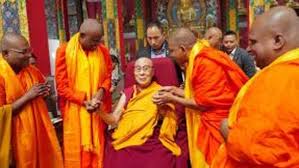
He told us that Christians, Hindus, and Muslims treat him well, but his own Buddhist brotherhood does not,” Upatissa recalled at the time. The question of whether the Dalai Lama’s childhood wish will be fulfilled resurfaced after the meeting between Most Venerable Dr. Pallegama Hemarathana Nayake Thero, the Atamasthanadhipathi of Sri Lanka, and His Holiness the 14th Dalai Lama. It was a historic encounter, drawing the attention of the global Buddhist community and reminding Sri Lanka of its moral responsibility as a guardian of Buddhism. Revered worldwide as a spiritual leader, the Dalai Lama has consistently rejected China’s interference, insisting that it is inappropriate for an avowedly atheist, communist government to dictate religious matters.
Though he has avoided direct confrontation, Beijing views him as a global threat to its control. The Dalai Lama announced last year that his successor will be named after his death, continuing a centuries-old tradition. His declaration—“I am affirming that the institution of the Dalai Lama will continue”—infuriated Beijing, which sees the institution as a challenge to its dominance in the Tibetan region.
China closely monitors his movements in Dharamsala, India, where he leads the government in exile. In 2017, Beijing strongly objected to his visit to Arunachal Pradesh. For China, the Dalai Lama is not a spiritual leader but a “splitter”—a separatist demanding autonomy for Tibet. India, however, insists that “no additional color should be ascribed to the Dalai Lama’s religious and spiritual activities,” defending his right to meet followers. For Indian Prime Minister Modi, the Dalai Lama has been an “enduring symbol of love, compassion, patience and moral discipline.” This difference in perspective highlights the broader geopolitical struggle: India frames the Dalai Lama as a spiritual leader, while China insists on politicizing his presence. The Dalai Lama also notes repeatedly that he has long been treated with great respect, provided high-level security, and privileges as an honored guest of the Indian government.
China’s hostility toward the Dalai Lama is rooted in history. In 1950, the People’s Liberation Army invaded Tibet, crushing hopes of self-rule. An uprising followed, later supported by the United States as part of its broader effort to counter communist expansion in Asia. American backing sustained Tibetan resistance for a time, but the movement ultimately failed, and thousands of Tibetans were killed.In March 1959, the PLA invited the Dalai Lama to a performance but insisted he attend without guards. Fearing assassination, he fled to India, where he has remained ever since.
From that moment, Beijing branded him a political enemy, while millions of Buddhists worldwide continued to see him as a spiritual guide. U.S. support ended as Washington pursued rapprochement with Mao’s China—a shift the Dalai Lama later described as harmful and one that weakened Tibet’s struggle for autonomy. In a later interview, he expressed dissatisfaction with U.S. moves, noting that the CIA connection was harmful: “Once the American policy toward China changed, they stopped their help. Otherwise our struggle could have gone on.”
Beijing may still have its reasons for treating him as a political threat, especially given its tense border relations with India. But why should Sri Lanka hesitate to welcome him if it truly seeks a balanced foreign policy? During Mahinda Rajapaksa’s regime, Sri Lanka even hosted Myanmar’s controversial Ashin Wirathu, who has been accused of stoking violence against Muslims in Myanmar. Yet when the Dalai Lama’s visit surfaced, a senior Foreign Ministry official admitted anonymously: “It will stir up a hornet’s nest, as it goes against Sri Lanka’s time-honored ‘One China’ policy. Lankans know China does not tolerate any country inviting the Dalai Lama.” Given this background, one could assume that China gave permission to invite Wirathu.
This admission exposes the heart of the issue: Sri Lanka’s foreign policy is not guided by its constitutional commitment to Buddhism or its claim of neutrality, but by fear of China’s reaction. Why then does a nation that claims neutrality and balance fear inviting a spiritual icon who embodies global Buddhism?
The historic meeting between Dr. Hemarathana Nayake Thero and the Dalai Lama has reignited a defining question for Sri Lanka: will President Anura Kumara Dissanayake continue decades of deference to Beijing, or fulfill his pledge of “system change”? While many small nations struggle to balance the influence of great powers, Sri Lanka’s case is unique—its constitutional role as guardian of Buddhism stands in stark contrast to its refusal to host the world’s most revered Buddhist figure. If Colombo cannot welcome His Holiness, it signals submission rather than neutrality. Aligning more closely with India may be geopolitically sound, but Sri Lanka must confront a deeper truth: can a nation that claims moral leadership in the Buddhist world allow its spiritual compass to be dictated by China’s veto?